![DNA-B-Primary_White (7).png]](https://kb.dnabehavior.com/hs-fs/hubfs/DNA-B-Primary_White%20(7).png?height=50&name=DNA-B-Primary_White%20(7).png)
Learned Behavior Discovery is a DNA Behavior methodology that measures the behaviors, preferences, and responses people develop through life experiences. While Natural Behavior reflects a person's enduring, hard-wired behavioral patterns, Learned Behavior reveals how individuals consciously adapt to different situations, environments, and responsibilities.
Together, these two perspectives provide a more complete understanding of human behavior. Natural Behavior explains who a person naturally is, while Learned Behavior explains who they have become through education, experience, values, beliefs, and intentional development.
Understanding both levels allows leaders, advisors, coaches, and individuals to better interpret performance, recognize behavioral growth, and identify opportunities for continued development.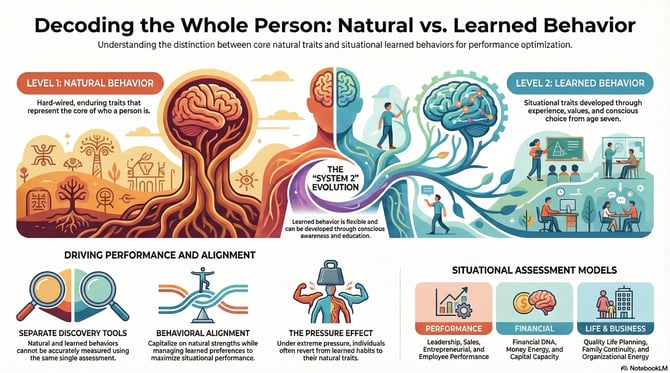
How Learned Behavior Works
1. Personality has two behavioral layers
DNA Behavior views personality as having two complementary dimensions.
Level 1: Natural Behavior
Natural Behavior represents an individual's instinctive, hard-wired behavioral tendencies. These patterns remain remarkably stable throughout life and describe how someone naturally thinks, communicates, makes decisions, and responds without conscious effort.
Level 2: Learned Behavior
Learned Behavior reflects the behaviors people intentionally develop through life. These behaviors are influenced by education, work experience, family, culture, values, coaching, and personal growth.
Unlike Natural Behavior, Learned Behavior changes over time as people adapt to new environments and responsibilities.
A useful way to understand this relationship is through the iceberg analogy:
- Natural Behavior forms the large foundation beneath the surface.
- Learned Behavior represents the visible portion that changes depending on circumstances.
Both are necessary to understand the complete behavioral picture.
2. Learned Behavior develops over time
Learned Behavior is not something people are born with.
It begins developing around the age of seven and continues evolving throughout life. The period between ages seven and fifteen is especially significant because it coincides with major cognitive, emotional, and social development.
As people encounter new situations, they continuously refine how they communicate, solve problems, lead others, manage finances, and pursue goals.
These adaptations become learned behavioral preferences that support success in specific environments.
3. Conscious behavior requires deliberate effort
DNA Behavior aligns Learned Behavior with Daniel Kahneman's concept of System 2 thinking.
System 2 behavior is:
- Conscious
- Intentional
- Analytical
- Effortful
- Situational
Unlike Natural Behavior, which operates automatically, Learned Behavior requires active decision-making and mental effort.
People often rely on Learned Behavior to meet workplace expectations, strengthen relationships, develop leadership capabilities, or perform responsibilities that differ from their natural tendencies.
Why Learned Behavior Requires Separate Discovery
Natural and Learned Behaviors cannot be accurately measured using a single assessment.
Natural Behavior measures enduring behavioral wiring.
Learned Behavior measures conscious preferences that vary according to context.
Because Learned Behavior changes depending on a person's environment and role, DNA Behavior uses separate discovery processes designed for specific situations rather than applying a single universal assessment.
This approach provides greater clarity by distinguishing between:
- What comes naturally.
- What has been intentionally developed.
- What is influenced by the current environment.
Separating these two dimensions allows organizations to make more informed coaching, leadership, and development decisions.
The Learned Behavior Discovery Models
DNA Behavior offers multiple Learned Behavior Discovery models that evaluate performance across different life and business contexts.
Performance Discoveries
These discoveries focus on improving workplace effectiveness and professional performance.
They include:
- Leadership Performance Discovery
- Advisor Performance Discovery
- Sales Performance Discovery
- Employee Performance Discovery
- Entrepreneurial Performance Discovery
Life and Planning Discoveries
These models help individuals improve personal effectiveness and long-term planning.
They include:
- Quality Life Planning Discovery
- Quality Life Performance Discovery
- DNA Behavior Goals Discovery
Financial and Organizational Discoveries
These discoveries evaluate financial behavior, organizational effectiveness, and long-term growth capacity.
They include:
- Financial DNA Learned Behavior Discovery
- Money Energy Discovery
- Money Opportunities Discovery
- Organizational Energy Discovery
- Quantum Leap Capacity Discovery
- Family Continuity Discovery
Each discovery focuses on a specific environment because learned behaviors vary according to the role, responsibilities, and circumstances being evaluated.
Behavior Under Pressure
One of the most valuable insights from Learned Behavior Discovery is understanding what happens during periods of stress.
Because Learned Behavior depends on conscious effort, it may become difficult to maintain under significant pressure.
When this occurs, individuals often return to their Natural Behavior.
This is known as the Reversion Effect.
For example:
Example 1: Organization under pressure
A naturally spontaneous individual may develop highly organized work habits through training and experience.
During periods of heavy workload or multiple deadlines, maintaining that learned structure becomes more difficult, and they may naturally return to a more spontaneous working style.
Example 2: Relationship management under pressure
Someone with a naturally task-focused style may consciously develop stronger relationship-building skills to become a more effective leader.
During high-pressure situations, they may temporarily rely less on emotional connection and communicate in a more direct, results-oriented manner.
These examples do not represent failure.
They simply illustrate the difference between consciously maintained behaviors and instinctive behavioral preferences.
Where Learned Behavior Discovery Is Used
Learned Behavior Discovery provides practical value across many leadership and coaching situations.
Leadership Development
Leaders can:
- Understand how their leadership style has evolved.
- Identify behaviors developed through experience.
- Recognize areas requiring continued development.
Coaching and Performance Improvement
Coaches can:
- Distinguish between natural strengths and learned capabilities.
- Measure behavioral growth over time.
- Design more personalized development plans.
Talent Development
Organizations can:
- Evaluate role alignment.
- Understand performance differences.
- Support employee growth through targeted coaching.
Financial and Life Planning
Advisors can:
- Understand behavioral influences on financial decisions.
- Monitor changes in financial habits.
- Support long-term behavioral improvement.
Why Learned Behavior Discovery Matters
Performance is influenced by both natural capability and learned adaptation.
Looking at only Natural Behavior explains what comes instinctively but does not show how someone has intentionally developed over time.
Looking at only Learned Behavior may overlook the enduring behavioral patterns that emerge under pressure.
Using both discoveries together provides a more complete understanding of human performance.
You can:
- Identify alignment between natural strengths and current responsibilities.
- Recognize behaviors developed through experience.
- Track behavioral evolution over time.
- Improve coaching effectiveness.
- Support sustainable personal and professional growth.
Rather than measuring who someone appears to be in one moment, this dual-layer approach explains both their natural behavioral foundation and the learned capabilities they've developed throughout life.
Summary
Learned Behavior Discovery complements Natural Behavior Discovery by measuring the conscious behaviors people develop through education, experience, and intentional growth.
It helps explain how people adapt to different environments, why behavior may change across situations, and why instinctive patterns often reappear during periods of stress.
Together, Natural Behavior and Learned Behavior provide a comprehensive framework for understanding behavior, improving performance, and supporting long-term personal and professional development.
For more information you can view this video.