![DNA-B-Primary_White (7).png]](https://kb.dnabehavior.com/hs-fs/hubfs/DNA-B-Primary_White%20(7).png?height=50&name=DNA-B-Primary_White%20(7).png)
Building a successful startup requires more than a great product or a promising market opportunity. The behavioral characteristics of the founders play a critical role in determining whether a business can innovate, grow, and successfully transition through each stage of development.
DNA Behavior approaches startup success through the lens of behavioral science. Rather than relying solely on intuition or traditional personality assessments, it measures the natural behavioral tendencies that influence leadership, decision-making, execution, and adaptability.
At the center of this approach is the Founder Paradox—the recognition that no single founder naturally possesses every behavioral strength required to lead a company from startup through maturity.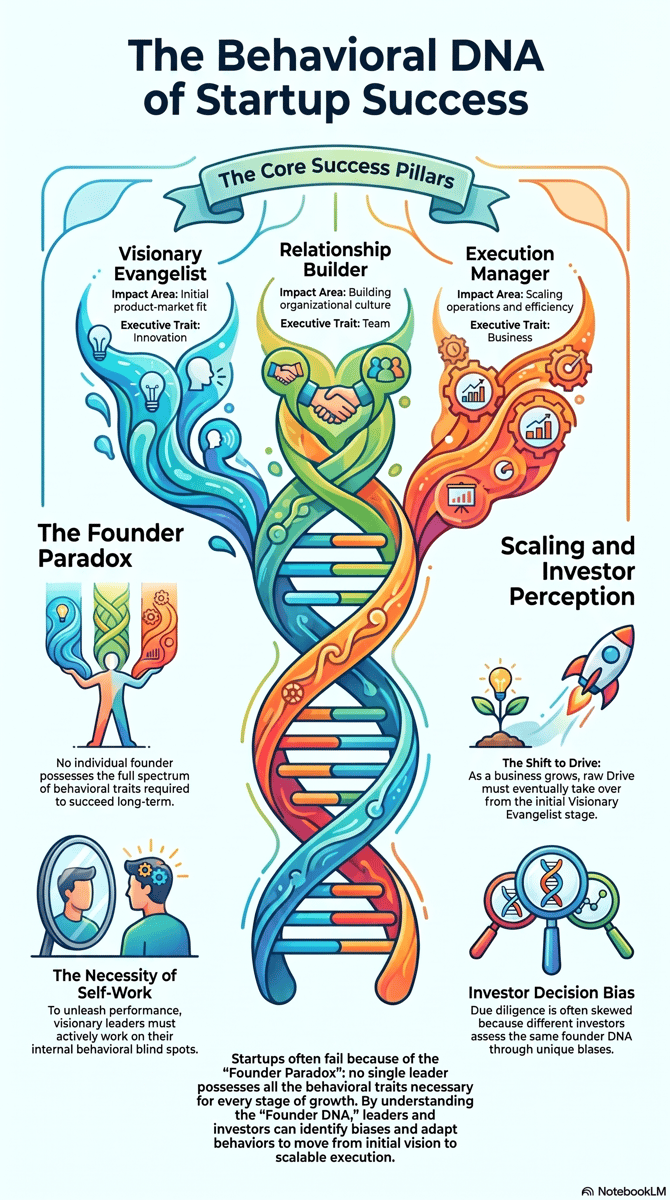
Understanding the Founder Paradox
The Founder Paradox recognizes that the behaviors required to launch a business are not always the same behaviors required to scale and manage one successfully.
Many founders excel at identifying opportunities, challenging conventional thinking, and inspiring early supporters. However, as the organization grows, new demands emerge that require different behavioral strengths, including operational discipline, team development, and organizational leadership.
As a result, startup success often depends on whether founders can:
- Develop new leadership capabilities.
- Recognize their behavioral blind spots.
- Build leadership teams with complementary strengths.
- Transition their role as the company evolves.
The most successful founders understand that business growth requires leadership growth.
The Three Core Components of Founder DNA
DNA Behavior identifies three essential behavioral pillars that influence startup performance.
1. Visionary Evangelist
The Visionary Evangelist provides the foundation for innovation.
Individuals with this behavioral strength naturally:
- Identify opportunities others overlook.
- Create compelling visions for the future.
- Inspire early customers and investors.
- Challenge existing assumptions.
- Generate new ideas and possibilities.
This behavioral style is particularly valuable during the earliest stages of a startup, when creativity and vision drive momentum.
2. Relationship Builder
As organizations grow, leadership becomes increasingly focused on people rather than ideas alone.
Relationship Builders naturally:
- Develop strong teams.
- Build trust across the organization.
- Create healthy workplace cultures.
- Encourage collaboration.
- Help individuals reach their potential.
Strong relationships become a competitive advantage as startups begin scaling.
3. Execution Manager
Ideas only become successful businesses through consistent execution.
Execution Managers naturally focus on:
- Delivering measurable results.
- Maintaining accountability.
- Building operational discipline.
- Making timely decisions.
- Driving projects to completion.
While visionary thinking starts the journey, disciplined execution enables sustainable growth.
How Founder Behavior Changes During Growth
The behavioral priorities of a startup evolve over time.
During the early stages, innovation and opportunity recognition are essential. Founders must identify unmet market needs, communicate a compelling vision, and attract early supporters.
As the business grows, operational complexity increases. Processes, systems, hiring, customer experience, and financial management require greater attention.
This creates an important leadership transition.
Early growth is often driven by visionary thinking.
Long-term success increasingly depends on execution.
Rather than replacing creativity, operational discipline becomes the dominant force that enables sustainable expansion.
Founders who successfully navigate this transition either develop these capabilities themselves or surround themselves with leaders whose behavioral strengths complement their own.
Behavioral Self-Awareness
One of the strongest predictors of founder success is self-awareness.
Successful founders recognize:
- Their natural strengths.
- Their behavioral limitations.
- Situations where complementary leadership is needed.
- When adapting their leadership style benefits the organization.
Behavioral awareness allows leaders to make better decisions about hiring, delegation, communication, and organizational design.
This isn't about changing who they are. It's about understanding how natural behavior influences business performance.
AI-Driven People Due Diligence
Traditional startup evaluations often focus on financial projections, product innovation, market opportunity, and business strategy.
While these factors are important, they may overlook one of the strongest predictors of future performance—the behavioral capability of the founding team.
DNA Behavior recommends incorporating AI-driven People Due Diligence into investment and leadership evaluation.
This approach includes:
- Measuring objective Behavior and Money Insights.
- Evaluating the behavioral composition of the founding team.
- Identifying strengths and potential gaps across leadership roles.
- Assessing founders' ability to adapt as the business evolves.
- Reducing subjective decision-making during investment evaluations.
Platforms such as Pegasus Ratings and DNA Behavior provide objective behavioral intelligence that helps investors move beyond first impressions and intuition.
Why Behavioral Due Diligence Matters
Investment decisions are often influenced by unconscious bias.
Different investors may evaluate the same founders differently based on charisma, confidence, communication style, or personal preference.
Objective behavioral measurement provides a more consistent framework for evaluating leadership potential.
Instead of asking whether founders appear impressive, investors can assess whether the leadership team possesses the behavioral balance needed for long-term success.
This creates better investment decisions while helping founders understand where additional leadership support may be required.
Key Takeaways
Startup success is driven by more than innovative ideas or market opportunity.
The behavioral composition of the founding team significantly influences how effectively a business can innovate, scale, build teams, and execute its strategy.
The Founder Paradox reminds us that every stage of business growth requires different leadership behaviors. Vision creates opportunity, relationships build strong organizations, and execution delivers sustainable results.
By using AI-driven behavioral intelligence to objectively evaluate Founder DNA, founders and investors can reduce subjective judgment, identify leadership gaps early, and make more informed decisions that improve the likelihood of long-term success.