![DNA-B-Primary_White (7).png]](https://kb.dnabehavior.com/hs-fs/hubfs/DNA-B-Primary_White%20(7).png?height=50&name=DNA-B-Primary_White%20(7).png)
A people-centric organization places human behavior at the center of every business decision. Rather than focusing solely on financial results, this approach recognizes that business outcomes are created by people—their decisions, communication styles, motivations, and relationships.
The core philosophy is simple: understand people before numbers.
Research highlighted within the DNA Behavior framework suggests that 87% of business issues are communication-related and stem from differences in human behavior. Financial metrics are important, but they are often the result of underlying human interactions. When organizations align their mission with employee aspirations and client goals, they create the conditions for sustainable growth.
This model is designed to help organizations move beyond traditional linear growth and create the foundation for exponential, people-driven performance.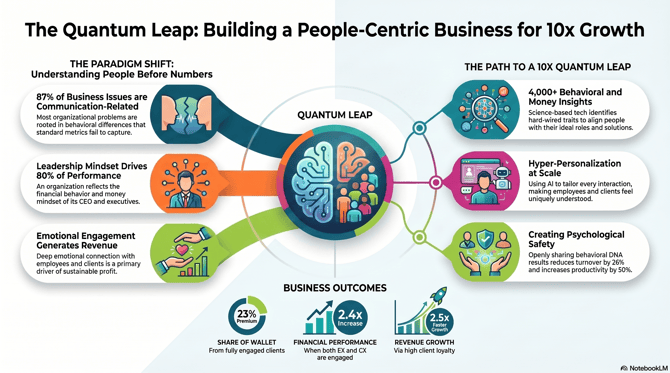
How It Works
The people-centric model is powered by DNA Behavioral Sciences Technology (BeSci Tech), a behavioral intelligence platform designed to measure how people work, communicate, make decisions, and interact with money.
1. Behavioral Measurement
The platform captures more than 4,000 behavioral and financial insights.
These insights help organizations better understand:
- Communication preferences
- Decision-making patterns
- Behavioral strengths
- Potential blind spots
- Financial attitudes and tendencies
2. Discovery and Assessment
Organizations can gather behavioral insights through multiple tools:
- DNA Full Discovery – A 46-question assessment with 97.1% reliability.
- DNA Digital Scan – An AI-powered behavioral heatmapping tool that reduces onboarding friction by analyzing publicly available information.
- DNA Web App – A dynamic platform that delivers real-time behavioral interpretation, coaching guidance, and Market Mood indicators.
3. Continuous Application
Behavioral insights are not intended to be a one-time exercise.
Instead, organizations use them throughout the employee, client, leadership, and business lifecycle to improve communication, decision-making, engagement, and performance.
Core Pillars of a People-Centric Organization
Psychological Safety
Psychological safety forms the foundation of a high-performing culture.
It begins when leaders model openness, vulnerability, and self-awareness. This creates a "Knowing Me, Knowing You" environment where people feel comfortable sharing ideas, admitting mistakes, and contributing without fear of judgment.
According to the framework, organizations with strong psychological safety experience:
- 26% lower turnover
- 76% higher employee engagement
- 50% higher productivity
When people feel safe, they participate more fully. That's where innovation and collaboration thrive.
Hyper-Personalization
A people-centric organization seeks to create a personalized experience for every employee and client.
The goal is to move beyond demographics and surface-level information to understand deeper behavioral drivers, motivations, needs, and preferences.
This creates stronger emotional connections and more relevant experiences.
Examples include:
- Personalized communication approaches
- Tailored client engagement strategies
- Customized employee development plans
- Behavioral-based coaching and mentoring
- Individualized service experiences
The framework notes that personalized email campaigns can generate 26% higher open rates, demonstrating the impact of behavioral relevance on engagement.
The Lighthouse Methodology
Organizations implement the people-centric model through a structured process known as the Lighthouse Methodology.
1. Business Performance Optimization
The process begins by aligning employee talents, behavioral strengths, and client needs.
This creates a clearer understanding of where performance opportunities and organizational bottlenecks exist.
2. Behavioral Heatmapping
Leaders use the DNA Digital Scan to visualize behavioral patterns across teams.
Heatmapping helps identify:
- Communication gaps
- Leadership bottlenecks
- Team misalignment
- Collaboration challenges
- Hidden performance constraints
Many of these issues remain invisible when leaders rely solely on financial metrics.
3. Behavioral Matching
Behavioral matching aligns employees, advisors, sales professionals, and service teams with clients based on communication and decision-making styles.
This approach has been shown to increase sales conversion rates by 10% to 30%.
The objective is straightforward: reduce friction and improve understanding.
Specialized Behavioral Applications
Behavioral Marketing
Behavioral marketing uses behavioral data to create more relevant messaging and experiences.
Instead of treating all prospects the same way, organizations tailor communication based on behavioral preferences and decision styles.
According to the framework, this approach can contribute to revenue growth of 23% or more.
Behavioral M&A Reviews
Traditional due diligence often evaluates financial, legal, and operational factors while overlooking leadership behavior.
Behavioral M&A reviews assess the behavioral risks and opportunities associated with leadership teams.
Benefits include:
- Reducing CEO bad hires from 54% to 10%
- Identifying leadership misalignment early
- Improving investment decision quality
- Supporting stronger post-acquisition integration
Managing Behavioral Variability
Expert judgment often varies significantly between individuals, creating inconsistent outcomes.
Behavioral training and digital twin technologies help reduce variability in areas such as:
- Hiring decisions
- Pricing decisions
- Leadership evaluations
- Performance assessments
The framework indicates variability can be reduced from 30–70% down to approximately 10%.
Behavioral Risk Management
Behavioral risks are often hidden until they affect performance.
Examples include:
- Dominant leaders limiting team participation
- Employees placed in roles that don't align with their natural strengths
- Communication breakdowns between departments
- Decision-making bottlenecks
Behavioral risk management helps organizations identify and address these challenges before they become larger business issues.
Why It Matters
Most organizations focus on improving systems, processes, and technology.
People-centric organizations focus on improving the human experience that drives those systems, processes, and technologies.
This is not about replacing business metrics. It's about understanding the human factors that create those metrics.
When organizations understand how people think, communicate, decide, and collaborate, they can create stronger cultures, better customer experiences, and more consistent business outcomes.
That's where exponential growth begins.
The Quantum Leap Outcome
The ultimate objective of a people-centric organization is to create transformational growth that extends beyond traditional business performance models.
According to the framework, organizations implementing these principles can achieve:
- 2.4x greater financial performance through stronger emotional engagement
- Earnings growth 2.5x faster than organizations that do not emotionally engage employees
- 74% lower stress levels across the organization
- 27% lower employee turnover when people feel their opinions matter
The broader vision is to help employees, leaders, clients, and stakeholders stress less, do more, and perform at their best for longer.
Summary
A people-centric organization recognizes that every business result starts with human behavior.
Using DNA Behavioral Sciences Technology, organizations can measure, understand, and apply behavioral intelligence across leadership, culture, client engagement, marketing, risk management, and strategic growth initiatives.
The result is a more aligned organization, stronger relationships, improved performance, and a foundation for sustainable long-term growth.