![DNA-B-Primary_White (7).png]](https://kb.dnabehavior.com/hs-fs/hubfs/DNA-B-Primary_White%20(7).png?height=50&name=DNA-B-Primary_White%20(7).png)
Behavioral intelligence is evolving from a specialized tool used primarily in recruitment and human resources into a core organizational capability. As businesses generate increasing amounts of demographic and transactional data, many are discovering that traditional data alone cannot fully explain why people make decisions, engage with products, or respond to services.
The next phase of organizational intelligence is centered on behavioral data. Rather than relying on assumptions or broad customer personas, organizations can use behavioral insights to better understand employees, clients, and stakeholders. This shift positions behavioral data as a valuable strategic asset that can support personalization, decision-making, innovation, and long-term growth.
Behavioral intelligence helps organizations move from making educated guesses to making informed decisions based on how people naturally think, communicate, and act.
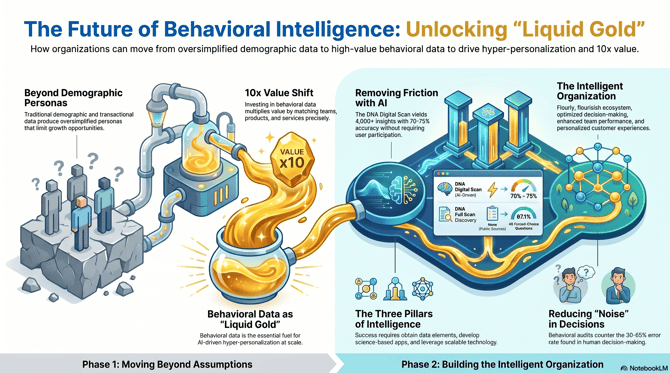
How Behavioral Intelligence Works
A behaviorally intelligent organization is built on three interconnected pillars.
1. Obtaining Data Elements
Organizations must first gather relevant behavioral data that provides meaningful insight into human decision-making and interaction patterns.
This data becomes the foundation for understanding:
- Communication preferences
- Decision-making tendencies
- Risk attitudes
- Motivational drivers
- Behavioral strengths and blind spots
Without quality behavioral data, meaningful behavioral intelligence cannot exist.
2. Behavioral Science Applications
Once behavioral insights are available, organizations can incorporate them into products, services, and operational processes.
Examples include:
- Financial wellness programs
- Health management initiatives
- Leadership development programs
- Customer engagement strategies
- Team effectiveness solutions
The goal is to create experiences that better align with how people naturally behave and make decisions.
3. Leveraging Technology
Technology allows behavioral intelligence to scale.
Rather than relying on one-on-one coaching or manual interpretation, organizations can embed behavioral insights into digital platforms, applications, and AI-driven systems.
This enables consistent personalization across large populations while maintaining efficiency and accessibility.
Understanding the DNA Behavior Methodology
Behavioral intelligence begins with understanding that human behavior operates across multiple layers.
Level 1: Natural DNA
Natural DNA represents a person's instinctive and hard-wired behavioral tendencies.
These traits remain relatively stable throughout life and influence how individuals:
- Process information
- Make decisions
- Communicate with others
- Respond to opportunities and challenges
This layer forms the foundation of behavioral intelligence.
Level 2: Learned Behaviors
Learned behaviors are skills and capabilities developed through education, training, experience, and conscious effort.
People can strengthen these behaviors over time and adapt them to meet specific personal or professional requirements.
Examples include:
- Leadership skills
- Financial management skills
- Sales techniques
- Communication methods
Level 3: Preferences
Preferences reflect a person's current wants, needs, interests, and situational priorities.
Unlike Natural DNA, preferences can change based on life circumstances, goals, or environmental influences.
Understanding all three levels provides a more complete picture of human behavior than traditional demographic data alone.
Building a Behavioral Data Strategy
Organizations seeking to leverage behavioral intelligence should adopt a structured data strategy centered on behavioral science.
1. Define Clear Objectives
Start by identifying the outcomes the organization wants to achieve.
Examples include:
- Improving customer engagement
- Increasing employee retention
- Strengthening leadership effectiveness
- Enhancing product adoption
- Supporting innovation initiatives
Clear objectives determine which behavioral data should be collected and analyzed.
2. Uncover Existing Data
Many organizations already possess valuable data scattered across different systems and departments.
Potential sources include:
- CRM platforms
- HR systems
- Learning platforms
- Customer service records
- Marketing databases
The first step is identifying and connecting these existing data sources.
3. Harmonize Data Quality
Behavioral intelligence depends on accurate and consistent information.
Organizations should audit data quality by examining:
- Completeness
- Accuracy
- Consistency
- Accessibility
Poor-quality data limits the effectiveness of any behavioral initiative.
4. Behavioralize the Data
Behavioralizing data means transforming raw information into human-centered insights.
The objective is to create experiences that make people feel understood.
This creates what many organizations describe as the "You get me" effect—when products, services, and communications align closely with an individual's behavioral preferences.
5. Establish Ethical Frameworks
Behavioral data must be collected and used responsibly.
Organizations should implement:
- Clear governance structures
- Privacy safeguards
- Transparent data practices
- Ethical AI standards
Trust is essential for long-term success.
The DNA Digital Scan Innovation
Historically, collecting psychometric and behavioral data created significant challenges.
Traditional assessments often required:
- Lengthy questionnaires
- High implementation costs
- Significant participant effort
- Extended analysis periods
New AI-powered approaches are reducing these barriers.
One example is the DNA Digital Scan, which can generate behavioral analytics by analyzing publicly available information and data patterns. These systems can achieve approximately 70% to 75% predictive accuracy without requiring individuals to complete extensive assessments.
This significantly reduces friction and allows behavioral intelligence to be deployed at much larger scales.
It is designed for speed and accessibility.
The Business Impact: The 10x Value Shift
Organizations investing in behavioral intelligence can create value across multiple areas.
Mass-Scale Personalization
Behavioral data allows organizations to deliver more relevant experiences by aligning products, services, and communications with individual preferences and decision styles.
Enhanced Due Diligence
Behavioral intelligence provides deeper understanding of people before important business, hiring, partnership, or investment decisions are made.
Decision Intelligence
Research shows that human decision-making can be affected by personality-driven biases and noise.
Behavioral intelligence helps reduce these blind spots by providing structured insight into how decisions are made.
Innovation
Traditional business metrics are often lagging indicators.
Behavioral data provides predictive insight that can be applied earlier in innovation cycles, helping organizations identify opportunities and risks before they appear in conventional reports.
Key Application Areas
Behavioral intelligence acts as a connecting layer across multiple organizational functions.
Employee Experience (EX)
Applications include:
- Recruitment and hiring
- Leadership development
- Culture transformation
- Employee engagement
- Wellness initiatives
Client Experience (CX)
Applications include:
- Marketing personalization
- Product design
- Financial planning
- Customer engagement
- Loyalty programs
Organizational Structure
Applications include:
- ESG initiatives
- Risk management
- Cybersecurity awareness
- Governance frameworks
- Strategic planning
Behavioral intelligence helps create stronger alignment between people, processes, and organizational objectives.
Why It Matters
Most organizations have access to enormous amounts of data.
The challenge is not collecting more information. The challenge is understanding people.
Behavioral intelligence bridges the gap between raw data and human decision-making. It helps organizations understand not only what happened, but also why it happened and what is likely to happen next.
As AI continues to evolve, behavioral data is becoming a critical component of decision intelligence, personalization, innovation, and organizational performance.
Organizations that combine behavioral science, quality data, and scalable technology will be better positioned to create meaningful experiences and make smarter decisions.
That's the future of behavioral intelligence.
Summary
Behavioral intelligence is moving beyond traditional HR applications and becoming a core business capability.
By combining behavioral science, enterprise data strategies, and AI-driven technologies, organizations can better understand employees, clients, and stakeholders at scale.
The result is more personalized experiences, better decisions, stronger innovation, and a more human-centered approach to data.