![DNA-B-Primary_White (7).png]](https://kb.dnabehavior.com/hs-fs/hubfs/DNA-B-Primary_White%20(7).png?height=50&name=DNA-B-Primary_White%20(7).png)
Hiring the right person is one of the most important decisions an organization makes. Traditional recruitment methods often result in costly hiring mistakes because they focus on limited information, subjective impressions, or incomplete assessments.
The DNA Hiring Performance Process provides a structured, behavior-based approach that helps organizations improve hiring accuracy by combining natural behavior insights with job profiling. Rather than relying on interviews alone, the process evaluates how well a candidate's natural behavioral strengths align with the requirements of a role and the people they will work with.
The goal is not to replace professional judgment. Instead, it provides additional behavioral intelligence that helps organizations make more informed hiring decisions while reducing the risk of poor role fit.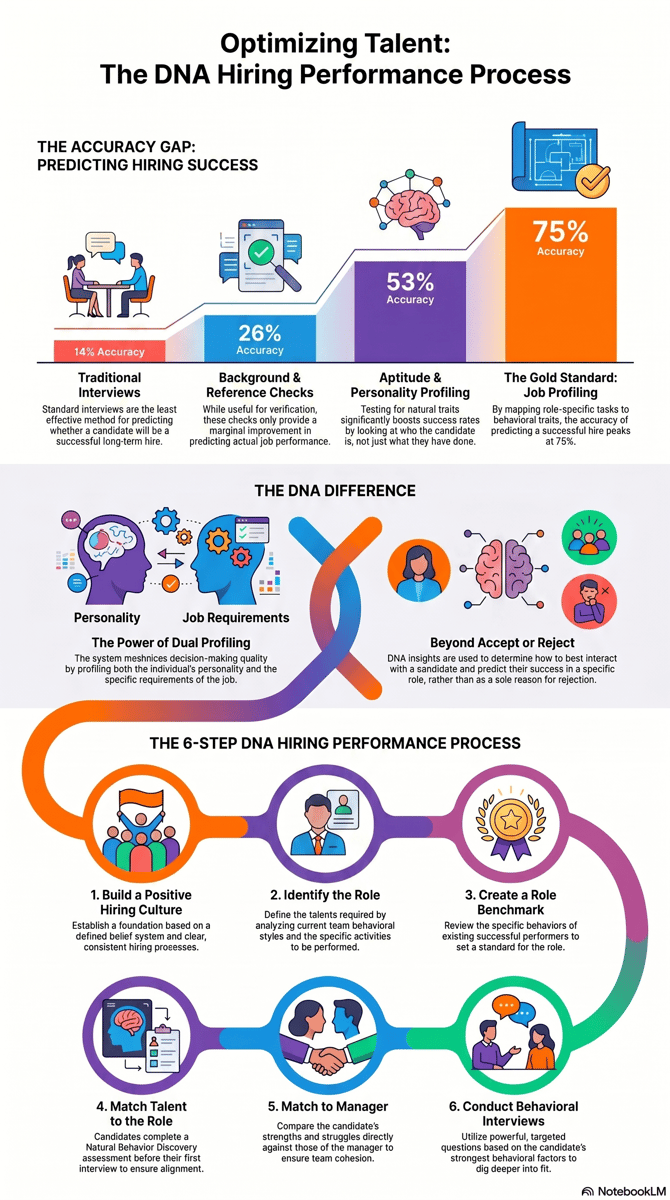
How Traditional Hiring Falls Short
Many organizations experience common hiring challenges, including:
- Hiring candidates who are not naturally suited to the role.
- Unclear understanding of the behavioral requirements of a position.
- Poor alignment between new employees and their managers.
- Team members whose work styles create unnecessary friction.
- High costs associated with replacing unsuitable hires.
Traditional recruitment methods often provide only part of the picture, making it difficult to predict long-term performance and workplace success.
Hiring Prediction Accuracy
Research conducted by Dr. John Hunter at Michigan State University demonstrates that different hiring methods vary significantly in their ability to predict successful job performance.
| Hiring Method | Predictive Accuracy |
|---|---|
| Interviews | 14% |
| Background and reference checking | 26% |
| Aptitude and personality profiling | 53% |
| Job profiling | 75% |
These findings demonstrate why relying solely on interviews or reference checks can lead to inconsistent hiring outcomes.
The DNA Hiring Performance Process combines behavioral profiling with job profiling to achieve a more comprehensive understanding of candidate suitability.
How the DNA Hiring Performance Process Works
The process combines two complementary components.
1. Job Profiling
Job profiling identifies the natural behavioral characteristics required for success in a specific role.
Rather than focusing only on qualifications or experience, it examines:
- The activities performed in the role.
- The natural behaviors that support those activities.
- The characteristics demonstrated by high-performing employees.
This creates a behavioral benchmark for future hiring decisions.
2. Candidate Profiling
Candidates complete the DNA Natural Behavior Discovery assessment to identify their natural behavioral strengths and tendencies.
The assessment helps organizations understand:
- Natural talents.
- Decision-making style.
- Communication preferences.
- Behavioral strengths.
- Areas that may require additional support.
This information provides valuable context throughout the recruitment process.
3. Matching Candidate to Role
Once both profiles are available, organizations compare the candidate's natural behavioral profile against the behavioral requirements of the position.
This comparison highlights areas of strong alignment while identifying potential challenges that may need further exploration during interviews.
The Six-Step DNA Hiring Performance Process
A successful implementation follows six structured steps.
1. Build a Positive Hiring Culture
Create a hiring process based on consistent principles, clearly defined expectations, and objective decision-making.
A strong hiring culture helps ensure every candidate is evaluated fairly and consistently.
2. Identify the Role
Clearly define:
- The responsibilities of the position.
- The behaviors required for success.
- The strengths demonstrated by successful employees performing similar work.
This establishes a clear understanding of what the organization is truly seeking.
3. Create a Role Benchmark
Develop a behavioral benchmark using the profiles of successful performers.
The benchmark serves as a reference point when evaluating future candidates.
4. Match Talent to the Role
Have candidates complete the DNA Natural Behavior Discovery assessment before the first interview.
Early behavioral insights allow interviewers to better understand each candidate before discussions begin.
5. Match the Candidate to the Manager
Behavioral compatibility between a manager and employee significantly influences long-term success.
Comparing both profiles helps identify:
- Shared strengths.
- Potential communication differences.
- Decision-making compatibility.
- Areas where coaching or support may be beneficial.
This helps establish stronger working relationships from the outset.
6. Conduct Behavioral Interviews
Use targeted behavioral interview questions based on each candidate's strongest behavioral factors.
Rather than asking generic interview questions, interviewers can explore how candidates naturally approach situations, solve problems, and make decisions.
This creates more meaningful conversations and provides deeper insight into potential job performance.
Best Practices for Using DNA Hiring Insights
The DNA Hiring Performance Process is designed to support—not replace—professional hiring judgment.
Behavioral insights should never be used as the sole reason to hire or reject a candidate.
Instead, they should help organizations:
- Ask better interview questions.
- Understand how candidates naturally work.
- Assess role alignment more effectively.
- Identify coaching opportunities.
- Make more informed hiring decisions.
Behavioral data provides another valuable perspective alongside experience, qualifications, references, and interviews.
Additional Resources
Organizations looking to expand their hiring capabilities can access additional support through DNA Behavior, including:
- Hiring consulting services.
- The publication A Guide to the DNA Hiring Performance Process.
- Related methodologies, including DNA Sustainable Performance.
- Human Capital optimization frameworks.
These resources provide additional guidance for organizations seeking to improve recruitment quality and long-term employee success.
Why the DNA Hiring Performance Process Matters
Every hiring decision has a lasting impact on organizational performance, culture, and employee engagement.
By combining job profiling, natural behavior assessment, manager alignment, and structured behavioral interviewing, organizations gain a more complete understanding of candidate suitability before making hiring decisions.
The process helps reduce guesswork, improves hiring consistency, and supports stronger long-term employee performance without relying solely on traditional recruitment methods.
Summary
The DNA Hiring Performance Process provides a structured framework for improving recruitment through behavioral intelligence.
By combining job profiling with natural behavior insights, organizations can better understand role requirements, evaluate candidate fit, strengthen manager relationships, and conduct more meaningful interviews. Used alongside traditional hiring methods, it supports better-informed decisions and helps reduce the cost of poor hiring outcomes.