![DNA-B-Primary_White (7).png]](https://kb.dnabehavior.com/hs-fs/hubfs/DNA-B-Primary_White%20(7).png?height=50&name=DNA-B-Primary_White%20(7).png)
The Behavioral Operating System (OS) represents a new way of using behavioral intelligence across an organization. Rather than treating behavioral assessments as a one-time activity, this approach embeds behavioral insights into the day-to-day systems, processes, and technologies that drive business performance.
Powered by the DNA Behavior intelligence platform, the Behavioral Operating System integrates behavioral data into the full lifecycle of a business. The goal is simple: help organizations make better decisions, improve human interactions, and create growth by understanding the behavioral drivers behind performance.
This approach combines behavioral science, technology, and artificial intelligence to create a people-centered framework that can scale across teams, departments, and entire industries.
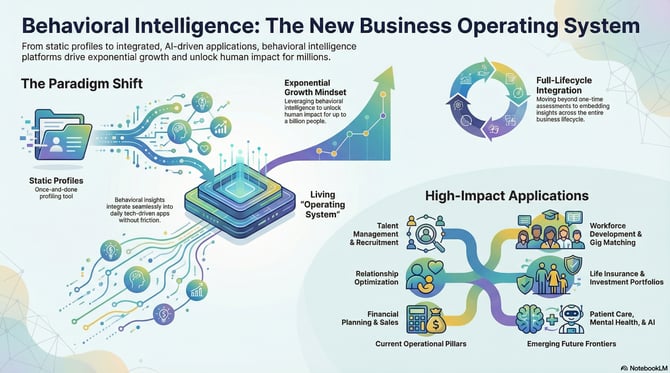
How the Behavioral Operating System Works
The Behavioral Operating System treats behavior as a foundational layer that supports organizational decision-making, much like a traditional operating system supports software applications.
1. Capture Behavioral Intelligence
The system gathers and interprets behavioral insights that help explain how people communicate, make decisions, respond to challenges, and interact with others.
These insights become part of an organization's broader intelligence framework rather than existing as isolated reports.
2. Integrate Insights into Technology
Behavioral intelligence is embedded directly into digital tools, workflows, and applications.
As technology continues to evolve, behavioral insights can be delivered seamlessly within existing business processes without creating additional administrative work.
3. Scale Across the Organization
Once integrated, behavioral intelligence can support decisions across multiple departments and functions.
The same behavioral framework can be applied to recruitment, leadership development, sales, financial planning, workforce management, and customer engagement.
4. Support Continuous Growth
Unlike static assessments that are reviewed once and forgotten, the Behavioral Operating System creates an ongoing feedback loop where behavioral insights continue to guide decisions and interactions over time.
Core Characteristics
Frictionless Integration
Behavioral insights become a natural part of everyday work rather than a separate activity.
AI-driven technology allows organizations to access behavioral intelligence when and where it is needed, reducing complexity and increasing adoption.
Scalability
The platform is designed to support organizations of any size.
Behavioral intelligence can be applied across individual teams, large enterprises, industry-specific solutions, and consumer-facing applications capable of reaching millions or even billions of people annually.
People-Centric Growth
Growth is driven by a deeper understanding of people.
Organizations that align business decisions with behavioral insights can create stronger cultures, improve engagement, and uncover opportunities that may otherwise remain hidden.
Current Business Applications
The Behavioral Operating System is already being used across multiple business functions.
Human Resources and Talent
You can use behavioral intelligence to support:
- Recruitment and candidate selection
- Talent management
- Employee engagement
- Career planning
- Workforce development
Leadership and Development
Behavioral insights help organizations:
- Develop leadership capability
- Support mentoring programs
- Evaluate leadership financial behavior
- Encourage entrepreneurship and innovation
Finance and Sales
Organizations apply behavioral intelligence to:
- Financial planning
- Sales effectiveness
- Marketing strategies
- Customer engagement
- Connection intelligence
Interpersonal Dynamics
Behavioral data can improve:
- Relationship development
- Team collaboration
- Communication effectiveness
- Conflict reduction
- Workplace alignment
The Future of the Behavioral Operating System
The long-term vision extends beyond traditional business functions and into highly personalized areas of daily life.
Financial and Risk Management
Future applications may support:
- Investment portfolio alignment
- Financial wellbeing programs
- Life insurance solutions
- Risk management
- Regulatory compliance
Healthcare and Wellness
Behavioral intelligence can contribute to:
- Patient engagement
- Healthcare decision support
- Wellness initiatives
- Mental health services
The Modern Workforce
Organizations can use behavioral insights to better match people with opportunities.
Potential applications include:
- Workforce development programs
- Gig economy role matching
- Career pathway recommendations
- Skills alignment initiatives
AI-Powered Digital Assistants
Behavioral intelligence can help create more personalized AI experiences.
Future AI assistants may be able to adapt recommendations, communication styles, and guidance based on an individual's behavioral preferences and decision-making patterns.
Legacy and Philanthropy Planning
Behavioral insights may also support:
- Family succession planning
- Wealth transition discussions
- Planned giving strategies
- Long-term family governance
Why It Matters
Most organizations collect large amounts of operational and transactional data. What is often missing is an understanding of the human behavior driving those outcomes.
The Behavioral Operating System helps bridge that gap.
By embedding behavioral intelligence into technology, processes, and decision-making frameworks, organizations can move beyond static information and create environments where people and technology work together more effectively.
This is not about using behavioral profiles once and moving on.
It's about making behavioral intelligence a permanent part of how the organization operates.
Summary
The Behavioral Operating System transforms behavioral intelligence from a standalone assessment into an integrated business capability.
It combines behavioral science, AI, and scalable technology to support better decisions, stronger relationships, and sustainable growth across every area of an organization.
Behavior becomes part of the operating system. Not an add-on.