![DNA-B-Primary_White (7).png]](https://kb.dnabehavior.com/hs-fs/hubfs/DNA-B-Primary_White%20(7).png?height=50&name=DNA-B-Primary_White%20(7).png)
Behavioral intelligence helps wealth management firms understand the human factors that influence financial decisions, communication, trust, and long-term client relationships. While many firms have sophisticated investment strategies and portfolio management systems, growth is often limited by behavioral misalignment rather than technical capability.
Communication misunderstandings, advisor-client mismatches, inconsistent team performance, and cultural challenges following mergers all reduce efficiency and client satisfaction. DNA Behavior's Behavioral Intelligence Platform addresses these challenges by transforming behavioral patterns into measurable, actionable data that can be embedded into everyday business processes.
Rather than focusing only on financial outcomes, the platform helps firms understand the behavioral drivers behind those outcomes, creating stronger relationships, better decision-making, and more personalized client experiences.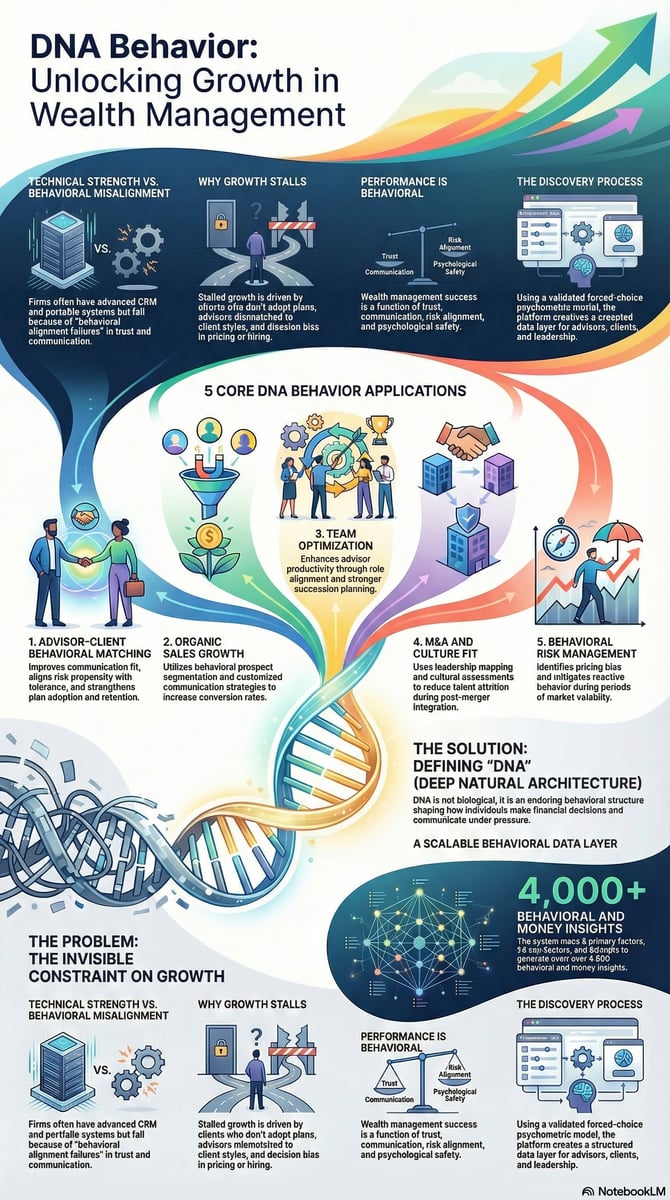
Understanding Deep Natural Architecture (DNA)
Within DNA Behavior, DNA stands for Deep Natural Architecture, not biological genetics.
Deep Natural Architecture represents an individual's enduring behavioral structure that influences how they naturally think, communicate, and make decisions throughout life.
This behavioral architecture influences how a person:
- Makes financial decisions
- Responds to investment risk
- Builds or withdraws trust
- Communicates under pressure
- Accepts or resists financial advice
- Processes information before making important decisions
The platform measures these behaviors using a validated forced-choice psychometric methodology that captures:
- 8 primary behavioral factors
- 24 behavioral sub-factors
- 64 measurable behavioral traits
- More than 4,000 unique behavioral and financial insights
This creates a structured behavioral data layer that advisors can use alongside traditional financial information.
How the Platform Works
Behavioral intelligence becomes operational by collecting, analyzing, and applying behavioral data throughout the client and advisor lifecycle.
1. Capture Behavioral Data
Behavioral information is collected using scientifically validated psychometric assessments or AI-powered behavioral prediction methods.
The platform offers three approaches:
- Full Behavioral Scan for comprehensive behavioral mapping of advisors and key clients.
- Quick Scan for rapid behavioral understanding of prospective clients.
- Digital Scan for AI-powered behavioral proxies that provide immediate directional insights.
2. Generate Behavioral Intelligence
The collected behavioral information is converted into practical insights that reveal how individuals naturally:
- Communicate
- Build trust
- Make decisions
- Process financial information
- Respond to uncertainty and investment risk
These insights become measurable data rather than subjective observations.
3. Apply the Insights
Behavioral intelligence can then be embedded into daily advisory activities, CRM systems, AI-powered analytics, and client engagement processes, allowing behavioral data to become part of everyday decision-making rather than a standalone assessment.
Core Applications for Wealth Management
Advisor–Client Matching
Behavioral intelligence improves the relationship between advisors and clients by aligning communication preferences, decision-making styles, and behavioral approaches to financial planning.
This helps firms:
- Improve client trust
- Increase client retention
- Generate more referrals
- Better align perceived investment risk with natural risk propensity
Organic Sales Growth
Behavioral segmentation allows firms to personalize communication throughout the sales process.
Advisors can:
- Tailor conversations to individual behavioral preferences
- Improve prospect engagement
- Increase conversion rates
- Reduce client acquisition costs
Team Optimization
Behavioral intelligence helps firms build stronger internal teams by placing advisors in roles that align with their natural behavioral strengths.
Benefits include:
- Reduced internal friction
- Improved collaboration
- Higher productivity
- Better alignment across advisory teams
M&A and Cultural Alignment
Behavioral mapping supports mergers and acquisitions by helping leadership understand cultural compatibility before and after integration.
The platform assists firms by:
- Mapping leadership strengths
- Assessing cultural fit
- Supporting integration planning
- Reducing talent loss following mergers
Behavioral Risk Management
Behavioral intelligence also supports better investment decision-making by identifying common behavioral biases that influence advisors and clients.
Applications include:
- Identifying pricing biases
- Reducing portfolio decision errors
- Supporting clients during periods of market volatility
- Improving consistency in financial advice
Business Benefits
Applying behavioral intelligence across a wealth management firm creates measurable operational improvements.
Organizations may benefit from:
- Higher client retention
- Increased share of wallet
- More referral opportunities
- Improved advisor productivity
- Better communication throughout the client journey
- Reduced hiring mistakes
- Stronger succession and generational wealth transition planning
- More efficient client interactions, including saving more than two hours per client annually through improved communication clarity
Behavioral intelligence shifts conversations from assumptions to measurable understanding.
Scientific Foundation
The DNA Behavior platform has been commercially operational since 2001.
Its behavioral methodology has been designed to:
- Reduce inflation bias
- Deliver reliable psychometric measurement
- Demonstrate long-term behavioral stability
- Provide internally validated behavioral insights
Rather than functioning as a one-time assessment, the platform integrates behavioral intelligence directly into business systems through CRM and API connectivity, making behavioral information available wherever decisions are made.
Implementation Approach
Organizations typically introduce behavioral intelligence using a phased implementation model.
1. Leadership Discovery
Behavioral insights are first used to align managing partners and executive leadership around communication, decision-making, and organizational priorities.
2. Advisor Team Mapping
Advisor behaviors are mapped to improve collaboration, clarify roles, and strengthen overall team performance.
3. Client Integration
Behavioral intelligence is incorporated into client engagement to personalize communication and improve the advisory experience.
4. Prospect Personalization
Behavioral insights are used to tailor outreach, improve prospect conversations, and increase conversion opportunities.
5. Data Integration
Behavioral information is connected with CRM platforms, AI systems, and governance processes so insights remain available throughout the client lifecycle.
Why Behavioral Intelligence Matters
Wealth management increasingly depends on personalization, trust, and long-term relationships rather than investment performance alone.
Behavioral intelligence provides a structured framework for understanding how people naturally think, communicate, and make financial decisions. By making these behavioral patterns measurable, firms can strengthen advisor-client relationships, improve internal performance, and support more consistent business growth.
Understanding portfolios remains essential. Understanding the people behind those portfolios is equally important.