![DNA-B-Primary_White (7).png]](https://kb.dnabehavior.com/hs-fs/hubfs/DNA-B-Primary_White%20(7).png?height=50&name=DNA-B-Primary_White%20(7).png)
Family business succession is often approached as a legal, tax, or financial exercise. While these elements are essential, they are rarely the primary drivers of a successful transition.
Succession is fundamentally a human dynamics event disguised as a financial one. The long-term success of any transition depends on how people think, communicate, make decisions, manage conflict, and adapt to changing roles. When these behavioral factors are ignored, even well-designed legal and governance structures can struggle to deliver the intended outcomes.
Understanding the human architecture behind succession helps families create transitions that preserve both business performance and family relationships.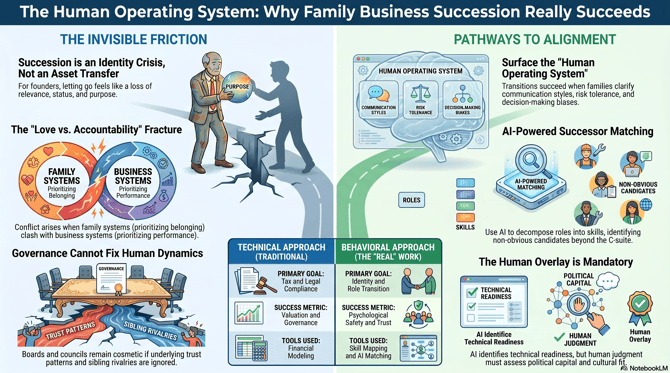
The Human Operating System
Every succession plan operates on two levels:
- The formal structure, including ownership, governance, and legal arrangements.
- The human operating system, which includes identity, psychology, communication, and relationships.
The formal plan defines what should happen. The human operating system determines whether it actually happens.
If underlying behavioral issues remain unresolved, succession often becomes delayed, contested, or unsuccessful despite technically sound planning.
1. Founder Identity
For many founders, the business represents much more than an asset.
It often becomes:
- A source of personal identity
- A measure of achievement
- A symbol of influence and purpose
- A lifelong mission
Stepping away from leadership can therefore feel like losing significance rather than simply transferring responsibilities.
A successful succession process addresses an important psychological question:
Who am I when I'm no longer the CEO?
Helping founders redefine purpose beyond executive leadership makes it significantly easier to transfer authority while maintaining confidence and engagement.
2. Decision Friction
Many succession delays are not caused by strategic disagreements.
Instead, they emerge from behavioral friction such as:
- Avoiding emotionally difficult conversations
- Long-standing sibling rivalry
- Differences in communication styles
- Conflicting attitudes toward risk
- Unspoken expectations between generations
These issues often remain hidden until major succession decisions must be made.
3. Psychological Safety
Families that navigate succession successfully typically create environments where difficult conversations can occur openly.
Psychological safety allows family members to:
- Express concerns honestly
- Challenge assumptions respectfully
- Clarify intentions before misunderstandings grow
- Discuss future leadership without fear of damaging relationships
Communication differences also play a major role. An analytical family member may unintentionally appear critical, while an intuitive communicator may appear vague. Understanding these natural differences reduces unnecessary conflict and improves trust throughout the transition.
Behaviorally Aligned Governance
Governance structures provide the framework for succession, but their effectiveness depends on whether family members genuinely accept and support them.
Boards, family councils, advisory groups, and decision-making frameworks function best when they reflect the behavioral strengths of the people expected to lead them.
Role Suitability
Leadership positions should be assigned based on behavioral suitability as well as technical capability.
Effective succession considers whether individuals naturally align with responsibilities such as:
- Strategic leadership
- Operational management
- Governance oversight
- Family representation
- Long-term stewardship
Authority becomes far more effective when it is both formally granted and psychologically accepted by everyone involved.
Defining Family and Business Boundaries
Healthy succession requires clear separation between family relationships and business responsibilities.
Families benefit from defining:
- Decision-making authority
- Employment expectations
- Performance standards
- Ownership responsibilities
- Conflict resolution processes
Clear boundaries reduce confusion while helping preserve both family harmony and organizational performance.
Belonging Versus Performance
Family systems naturally prioritize belonging.
Businesses prioritize performance.
These priorities occasionally conflict.
One of the greatest succession challenges occurs when underperforming family members remain in critical roles to preserve family harmony.
While this may reduce short-term conflict, it can gradually weaken both the business and family relationships.
Successful succession balances compassion with accountability by maintaining consistent expectations for every leadership role.
Using AI to Improve Successor Identification
Artificial intelligence is changing how organizations identify and develop future leaders.
Rather than relying entirely on subjective discussions or annual talent reviews, AI can provide data-driven insights that improve succession planning.
Skill-to-Role Mapping
AI can break leadership positions into measurable competencies and compare candidates against those requirements.
This allows organizations to evaluate successors using consistent criteria rather than relying solely on personal opinion.
Internal Talent Marketplaces
Potential successors are not always the most visible employees.
AI can identify individuals across the organization whose skills, experience, and development trajectory closely match future leadership requirements, even when they have not previously been considered.
This expands the available talent pool and reduces the likelihood of overlooking high-potential candidates.
Readiness Scoring
Instead of assigning simple labels such as "ready now" or "not ready," AI can estimate leadership readiness by identifying:
- Current capability gaps
- Development priorities
- Estimated time to readiness
- Potential flight risks among high-performing employees
These insights support more targeted leadership development over time.
The Human Overlay
AI is a valuable decision-support tool, not a replacement for human judgment.
Behavioral dynamics such as political credibility, cultural fit, trust, and board confidence remain difficult to measure through algorithms alone.
Organizations that rely exclusively on AI recommendations risk selecting leaders who possess strong technical qualifications but lack the relational capabilities required for long-term success.
The strongest succession decisions combine objective analytics with experienced human judgment.
When to Apply This Approach
A behavior-centered succession framework is valuable whenever leadership continuity has long-term strategic importance.
Typical applications include:
Family-Owned Businesses
- Preparing ownership transitions
- Developing next-generation leaders
- Reducing family conflict
- Preserving long-term business value
Private Companies
- CEO succession planning
- Executive leadership development
- Board succession discussions
- Leadership pipeline planning
Enterprise Organizations
- High-potential talent identification
- Strategic workforce planning
- Executive readiness assessments
- Leadership continuity programs
Advisory Professionals
- Family business consultants
- Wealth advisors
- Executive coaches
- Governance specialists
- Succession planning professionals
Why Behavioral Succession Matters
Traditional succession planning focuses heavily on transferring assets and authority.
Behavioral succession focuses on transferring trust, confidence, relationships, and leadership identity.
When families understand how individuals naturally communicate, make decisions, respond to uncertainty, and handle conflict, succession becomes significantly more intentional.
Instead of reacting to crises, families can proactively design leadership transitions that strengthen both the business and the family.
The strongest succession plans combine legal, financial, governance, behavioral, and technological perspectives into a single integrated process.
Summary
Succession is more than a transfer of ownership. It is a transition of leadership, identity, responsibility, and trust across generations.
While legal structures, governance, and financial planning provide the foundation, long-term success depends on understanding the behavioral architecture of the people involved. By combining behavioral intelligence, psychologically aligned governance, and AI-supported succession insights with experienced human judgment, families and organizations can build transitions that are both effective and sustainable.
For more information you can view this video.