![DNA-B-Primary_White (7).png]](https://kb.dnabehavior.com/hs-fs/hubfs/DNA-B-Primary_White%20(7).png?height=50&name=DNA-B-Primary_White%20(7).png)
Scaling a business requires more than a well-defined strategy. While frameworks such as Scaling Up provide a structured approach across Strategy, Execution, Cash, and People, successful implementation depends on the behavior of the people responsible for delivering that strategy.
The DNAB Behavioral Intelligence Platform provides the missing behavioral layer that helps organizations execute consistently, align leadership teams, and build cultures capable of sustaining long-term growth. Rather than relying on assumptions or intuition, the platform uses measurable behavioral data to identify leadership strengths, execution risks, and organizational constraints before they affect performance.
Behavior explains why strategies succeed or fail. Financial results describe what has already happened, while behavioral data provides insight into what is likely to happen next.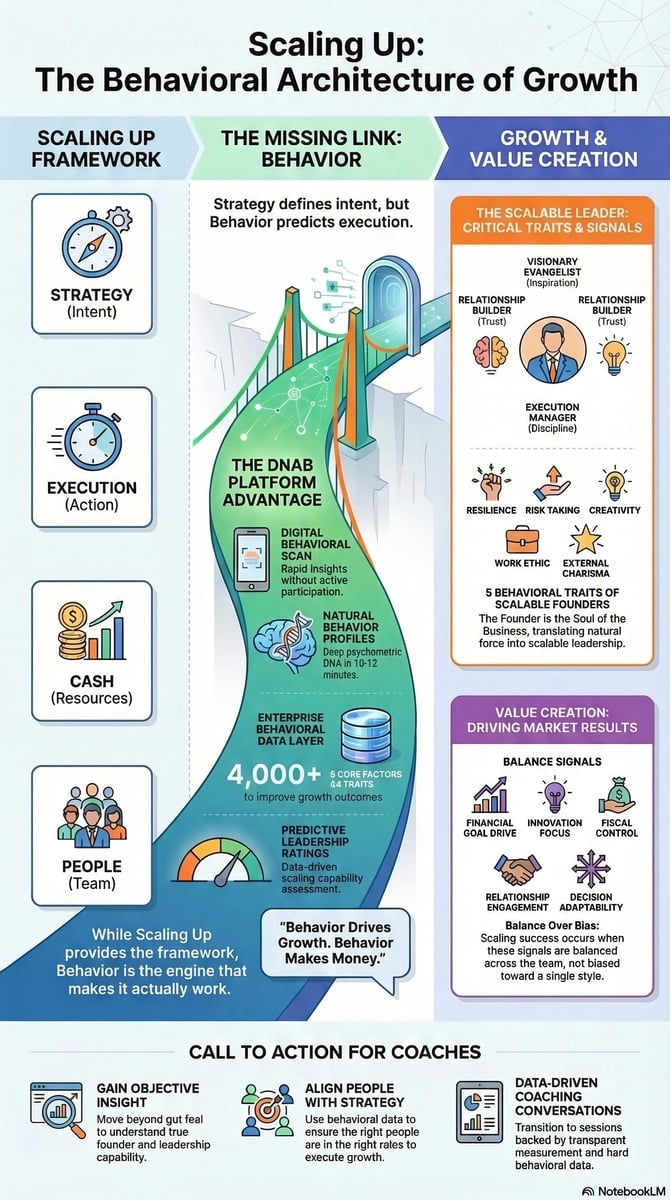
How It Works
The DNAB platform measures the behavioral architecture of leaders, teams, and organizations to support better business execution.
1. Measure Leadership Behavior
The platform evaluates the natural behavioral patterns of leaders and executive teams using scientifically developed behavioral assessments and predictive behavioral models.
This creates an objective understanding of how leaders naturally think, communicate, make decisions, manage risk, and influence others.
2. Identify Leadership Balance
Successful organizations require more than visionary leadership. They need complementary behavioral strengths that support execution, culture, and accountability.
The platform helps identify whether leadership teams have the behavioral balance required to scale effectively.
3. Improve Execution
Once behavioral strengths and constraints are identified, organizations can make more informed decisions about leadership development, coaching, succession planning, role alignment, and organizational design.
The result is stronger execution with less friction across the business.
Core Leadership Architecture
The platform identifies several behavioral factors that influence an organization's ability to scale.
The Three Critical Founder Signals
High-growth organizations require balance across three essential leadership roles:
- Visionary Evangelist – Creates vision, identifies opportunities, and inspires future growth.
- Relationship Builder – Develops trust, strengthens culture, and builds collaborative teams.
- Execution Manager – Creates discipline, accountability, and operational consistency.
Many founders naturally excel in visionary thinking. Sustainable growth occurs when the remaining leadership capabilities are intentionally developed or added to the executive team.
Five Traits of Scalable Founders
Research highlighted by the platform identifies five behavioral characteristics commonly associated with leaders who successfully scale organizations:
- Resilience
- Risk Taking
- Creativity
- Work Ethic
- External Charisma
These characteristics help leaders navigate uncertainty while maintaining momentum during periods of rapid growth.
Five Signals of Value Creation
Long-term profitability depends on balancing five behavioral drivers:
- Financial Goal Drive
- Innovation Focus
- Fiscal Control
- Relationship Engagement
- Decision Adaptability
Rather than maximizing one behavior, successful organizations maintain balance across all five areas.
Identifying Behavioral Constraints
Organizations often struggle to scale because behavioral barriers remain hidden.
The DNAB platform helps identify common constraints before they become operational problems.
Cost Controller Leadership
Some leaders naturally prioritize efficiency above growth opportunities.
While financial discipline is important, excessive cost control can reduce innovation, limit investment, and slow long-term expansion.
Founder Dependency
Organizations become difficult to scale when major decisions remain dependent on one individual.
Behavioral measurement helps determine where additional leadership capability should be developed to create a more resilient organization.
Leadership Misalignment
Executive teams frequently experience conflict because members naturally process information, communicate, and make decisions differently.
Understanding these differences reduces unnecessary friction and improves collaboration.
Intuition Bias
Many organizations continue making people decisions based primarily on instinct.
Behavioral data provides objective evidence that supports better hiring, leadership development, succession planning, and executive coaching.
Platform Capabilities
The DNAB Behavioral Intelligence Platform combines multiple behavioral tools to create an enterprise-wide behavioral data layer.
Digital Behavioral Scan
Provides rapid behavioral insight into leaders and teams without requiring direct participation.
This enables organizations to begin understanding behavioral dynamics quickly and at scale.
Natural Behavior Profiles
A comprehensive 10 to 12-minute psychometric assessment that measures an individual's Deep Natural Architecture and provides detailed behavioral insight.
Enterprise Behavioral Data Layer
The platform measures:
- 8 core behavioral factors
- 64 behavioral traits
- More than 4,000 behavioral insights
This information supports better leadership decisions throughout the organization.
Leadership Ratings
Predictive leadership indicators help assess an individual's capability to lead organizational growth and scale effectively.
Where It's Used
Scaling Up Coaches
Behavioral intelligence enables coaches to move beyond observation and intuition by providing measurable insight into leadership capability.
Common applications include:
- Leadership coaching
- Executive development
- Team alignment
- Strategic role allocation
- Succession planning
Growth Leaders
Business leaders can use behavioral intelligence to:
- Build accountability across leadership teams
- Improve decision-making quality
- Reduce organizational friction
- Strengthen execution
- Develop scalable leadership capability
- Create healthier organizational cultures
Why It Matters
Business growth depends on consistent execution.
Even the strongest strategic plan will struggle if leadership behaviors are misaligned with the organization's goals.
Behavioral intelligence provides leaders with objective data about how people naturally work, collaborate, make decisions, and respond under pressure. This allows organizations to identify hidden risks earlier, strengthen leadership capability, and build systems that continue performing as the business grows.
Scaling is not simply about improving processes or introducing better systems.
It's about creating behavioral alignment across the entire organization.
When strategy and behavior work together, execution becomes more predictable, leadership becomes more effective, and sustainable growth becomes significantly easier to achieve.
Summary
The DNAB Behavioral Intelligence Platform complements the Scaling Up framework by providing the behavioral insights needed to execute strategy more effectively.
By measuring leadership behavior, identifying execution constraints, and aligning teams around shared objectives, organizations can reduce founder dependency, improve decision-making, and build a culture designed for sustainable growth.