![DNA-B-Primary_White (7).png]](https://kb.dnabehavior.com/hs-fs/hubfs/DNA-B-Primary_White%20(7).png?height=50&name=DNA-B-Primary_White%20(7).png)
Organic sales growth is often viewed as the result of stronger products, better pricing, or increased market demand. While these factors matter, they are rarely the primary reason organizations either accelerate or stall their growth.
The Behavioral Architecture of Organic Sales Growth approaches sales from a different perspective. Rather than focusing solely on external market conditions, it examines the behavioral alignment between sales professionals, customers, leadership, and organizational systems. Using Deep Natural Architecture (DNA), organizations can identify the behavioral patterns that influence trust, communication, decision-making, and long-term commercial success.
This framework enables organizations to replace assumptions with measurable behavioral intelligence, creating consistent improvements that compound over time.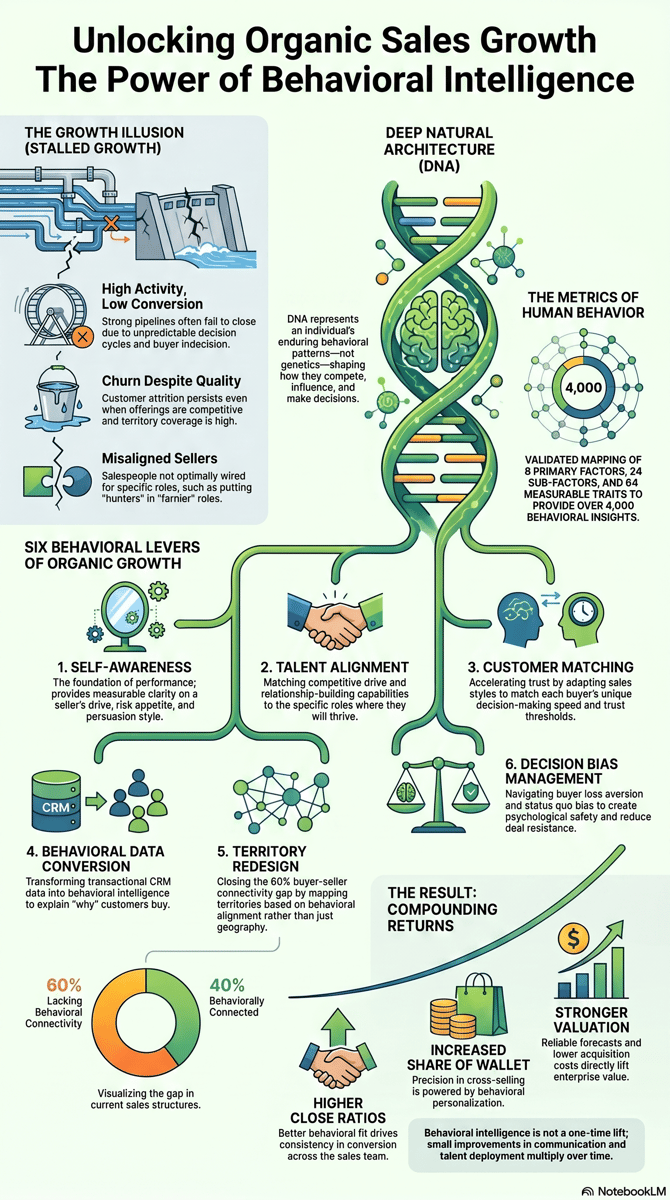
How It Works
Behavioral intelligence begins by understanding the natural behavioral architecture of every individual involved in the sales process.
1. Measure Natural Behavior
Deep Natural Architecture (DNA) represents an individual's enduring behavioral patterns rather than their biological genetics. These natural tendencies influence how people:
- Build trust
- Communicate with others
- Compete
- Influence decisions
- Evaluate risk
- Make buying and selling decisions
These behaviors are measured through a validated psychometric process that evaluates:
- 8 primary behavioral factors
- 24 behavioral sub-factors
- 64 measurable behavioral traits
- More than 4,000 behavioral insights
This creates a measurable behavioral foundation that can be applied consistently across an organization.
2. Apply Behavioral Intelligence
Once behavioral data is available, organizations can apply it throughout the entire commercial ecosystem, including:
- Sales executives
- Individual sales professionals
- Leadership teams
- Existing customers
- Prospective customers
This makes trust, communication, and relationship quality measurable rather than subjective.
3. Continuously Improve
Behavioral intelligence is designed to become part of everyday sales execution rather than a one-time assessment.
As behavioral insights are incorporated into hiring, customer engagement, CRM systems, coaching, and leadership decisions, improvements continue to build over time.
Six Behavioral Levers of Organic Growth
Self-Awareness
High-performing sales professionals first understand their own behavioral wiring.
This includes recognizing natural tendencies such as:
- Risk appetite
- Communication style
- Persuasion approach
- Decision-making preferences
Greater self-awareness helps prevent overusing natural strengths while reducing behaviors that unintentionally create resistance with buyers.
Talent Alignment
Not every successful salesperson is suited to every sales role.
Behavioral intelligence helps organizations match individuals with responsibilities that align with their natural strengths.
For example:
- Sales professionals with strong Competitive Drive often perform best in new business acquisition and closing opportunities.
- Professionals with stronger Relationship Connection may be better suited to account management, client retention, and long-term relationship development.
Matching behavior to role improves both performance and job satisfaction.
Customer Behavioral Matching
Customers process information differently.
Some prefer fast decisions with minimal detail, while others require greater certainty before moving forward.
Behavioral matching allows sales professionals to adapt:
- Communication style
- Decision pace
- Information depth
- Risk discussions
- Persuasion techniques
Trust becomes intentionally designed rather than left to chance.
Behavioral Data Conversion
Traditional sales systems explain what happened.
Behavioral intelligence explains why it happened.
By integrating behavioral insights into CRM platforms and AI systems, organizations can develop:
- Personalized customer engagement
- Behavioral segmentation
- More targeted marketing
- Improved sales conversations
- Better forecasting
This transforms transactional information into actionable intelligence.
Territory Optimization
Many organizations assign territories based primarily on geography, industry, or revenue potential.
Research presented within this framework suggests that approximately 60% of buyer-seller interactions lack meaningful behavioral connectivity.
Behavioral territory design seeks to improve this alignment by considering behavioral compatibility alongside traditional territory planning.
The result can be stronger customer relationships and improved expansion opportunities without increasing headcount.
Decision Bias Management
Every buying decision is influenced by cognitive bias.
Behavioral intelligence helps sales professionals recognize common decision barriers, including:
- Loss aversion
- Status quo bias
- Uncertainty around risk
- Hesitation during major decisions
Understanding how buyers naturally evaluate risk helps create greater psychological safety, reducing friction throughout the sales process.
Where It's Used
Sales Leadership
Behavioral intelligence supports sales leaders by helping them:
- Build behaviorally balanced teams
- Improve forecasting reliability
- Coach individuals more effectively
- Align talent with business objectives
Sales Teams
Sales professionals can use behavioral intelligence to:
- Prepare for customer meetings
- Improve communication
- Build trust more quickly
- Increase close rates
- Reduce unnecessary sales friction
Customer Growth
Organizations can strengthen customer relationships by:
- Increasing share of wallet
- Improving customer retention
- Reducing acquisition costs
- Creating more personalized customer experiences
Why It Matters
Many organizations assume sales growth is constrained by market conditions.
This framework argues that sustainable growth is more often constrained by behavioral misalignment.
When leadership, sales professionals, customers, and supporting technology operate from a shared understanding of behavior, communication improves, decisions become more effective, and relationships strengthen naturally.
Small improvements made consistently across hiring, communication, coaching, customer engagement, and territory management do not remain isolated. They compound over time.
This compounding effect contributes to:
- Higher close ratios
- Faster sales cycles
- Reduced customer churn
- Improved forecast accuracy
- Greater customer lifetime value
- Stronger enterprise valuation
Products and pricing become increasingly similar across many industries.
Behavior becomes the competitive advantage.
Implementation Framework
Organizations typically implement behavioral intelligence through six progressive phases:
1. Discovery
Assess leadership behaviors and establish a behavioral baseline.
2. Talent Alignment
Match individuals to roles that best fit their natural behavioral strengths.
3. Customer Integration
Apply behavioral insights throughout customer engagement and relationship management.
4. Data Integration
Integrate behavioral intelligence into CRM platforms, AI systems, and customer workflows.
5. Territory Optimization
Redesign territories using behavioral compatibility alongside traditional planning methods.
6. Ongoing Governance
Continuously monitor, refine, and reinforce behavioral practices across the organization to support long-term organic growth.
Summary
The Behavioral Architecture of Organic Sales Growth demonstrates that lasting commercial success depends on more than products, pricing, or activity levels.
By measuring natural behavior, aligning talent with the right roles, adapting to customer decision styles, and embedding behavioral intelligence into everyday operations, organizations create an environment where growth becomes more predictable and sustainable.
Behavioral intelligence transforms sales from reactive execution into a disciplined system for building trust, improving decisions, and creating compounding long-term value.
For more information you can view this video.