![DNA-B-Primary_White (7).png]](https://kb.dnabehavior.com/hs-fs/hubfs/DNA-B-Primary_White%20(7).png?height=50&name=DNA-B-Primary_White%20(7).png)
The wealth management industry is entering a new phase of transformation. While global Assets Under Management (AUM) are expected to grow from approximately $139 trillion today to nearly $200 trillion by 2030, profit margins continue to shrink due to fee compression and rising operating costs.
This creates a new challenge. Growth alone is no longer enough to drive profitability.
As a result, firms are shifting from a model built primarily on scale to one built on intelligence. The next competitive advantage is not simply managing assets more efficiently. It's understanding the people behind those assets.
The Industry Challenge: The Profitability Paradox
For decades, wealth management success was measured largely by asset growth. More assets meant more revenue.
That equation is changing.
Despite significant growth in managed assets, industry profit margins have declined by nearly 19% since 2018. Firms now face increasing pressure to deliver more value while operating more efficiently.
This shift is forcing organizations to rethink how they create and measure value.
Instead of focusing only on portfolios, firms are beginning to focus on the behavioral factors that influence financial outcomes.
From Quanta to Qualia
The first wave of artificial intelligence in wealth management focused on what can be called the Quanta of finance.
This includes:
- Portfolio automation
- Rebalancing
- Tax optimization
- Reporting and analytics
- Operational efficiency
These capabilities remain important. However, they primarily address the numerical side of wealth management.
The next frontier is the Qualia—the human side of financial decision-making.
This includes:
- Trust preferences
- Emotional triggers
- Communication styles
- Risk posture
- Decision-making tendencies
These factors often determine whether clients stay disciplined during market volatility, follow financial plans, or make emotional decisions that affect long-term outcomes.
The Behavioral Iceberg
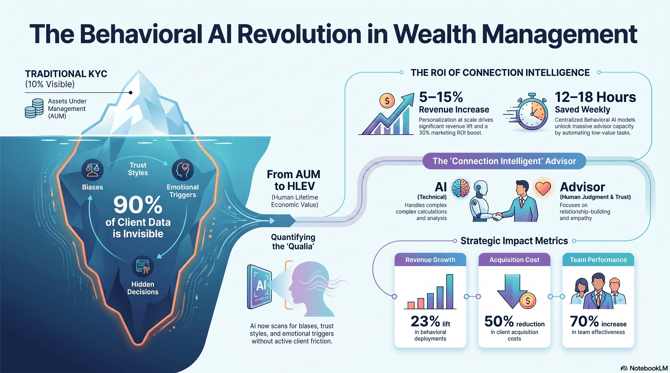
Traditional financial data reveals only a small portion of what drives client behavior.
Think of it as an iceberg.
The visible portion includes:
- Transaction history
- Investment allocations
- Demographic information
- Account balances
Beneath the surface are the factors that often influence outcomes the most:
- Trust styles
- Emotional responses
- Behavioral motivators
- Risk perceptions
- Communication preferences
This hidden behavioral layer represents the majority of the decision-making process.
As a result, behavioral data is increasingly viewed as one of the most underutilized strategic assets in financial services.
Behavioral Data as a Strategic Asset
Behavioral data provides insight into how people are likely to act, not just what they have done in the past.
This changes the quality of advice that advisors can provide.
New technologies such as DNA Digital Scan make it possible to gather behavioral insights quickly and with significantly less friction than traditional assessments.
You get:
- Faster client understanding
- More personalized communication
- Better alignment between advice and behavior
- Greater confidence in client engagement strategies
Most firms have extensive financial data. Far fewer have meaningful behavioral intelligence.
That's where the opportunity exists.
Redefining Value with Human Lifetime Economic Value (HLEV)
One of the most significant shifts enabled by Behavioral AI is the move from measuring Assets Under Management (AUM) to measuring Human Lifetime Economic Value (HLEV).
HLEV focuses on a person's long-term economic trajectory rather than simply their current asset base.
It combines factors such as:
- Behavioral patterns
- Expected lifespan
- Economic behaviors
- Financial decision-making tendencies
- Biometric and longevity-related insights
In this model, the value of an advisor is no longer defined solely by assets managed.
It's increasingly defined by the Human Lifetime Economic Value they help create and preserve.
The Evolution of the Financial Advisor
Behavioral AI is not designed to replace advisors.
It's designed to amplify them.
AI can absorb many operational responsibilities, including:
- Research synthesis
- Compliance monitoring
- Administrative tasks
- Data aggregation
- Routine client interactions
This allows advisors to focus on higher-value activities that require human judgment and trust.
Connection Intelligence
As AI handles more operational work, the advisor's competitive advantage becomes increasingly behavioral.
The new advisor alpha includes:
- Reading behavioral signals
- Building trust
- Coaching clients through uncertainty
- Helping clients remain disciplined during volatility
- Strengthening long-term relationships
Technology can automate processes.
Trust remains human.
AI Copilots and Digital Twins
Behavioral AI also introduces new operating models.
An AI Copilot can support advisors by managing routine interactions, surfacing insights, and providing recommendations.
A Digital Twin can extend an advisor's unique decision-making style, helping deliver more consistent experiences across larger client bases.
The advisor remains the pilot.
AI becomes the support system.
Personalization at Scale
Deep personalization has traditionally been reserved for a small percentage of clients.
Behavioral AI changes that equation.
By combining AI with behavioral intelligence, firms can move toward delivering highly personalized experiences across nearly their entire client base.
This allows organizations to:
- Tailor communication styles
- Adapt engagement strategies
- Improve client satisfaction
- Strengthen retention
- Scale advisor effectiveness
Personalization no longer has to be limited by advisor capacity.
Investment Management 2.0: Leadership Intelligence
Behavioral AI also changes how investment opportunities are evaluated.
Traditionally, analysis has focused on financial performance, balance sheets, and market indicators.
Behavioral intelligence introduces another dimension.
It allows firms to assess leadership characteristics such as:
- Resilience under pressure
- Fiscal discipline
- Innovation orientation
- Strategic consistency
- Decision-making behavior
This creates a new question for investors.
Instead of asking:
What are we investing in?
They can also ask:
Who are we investing behind?
Business Impact and ROI
Organizations implementing Behavioral AI can generate measurable benefits across multiple areas.
Revenue Growth
Behavioral personalization can contribute to:
- Higher client engagement
- Increased retention
- Stronger advisor-client relationships
- Revenue increases ranging from 5% to 15%
- Additional gains from behavioral deployment strategies
Cost Reduction
Behavioral intelligence can help reduce:
- Client acquisition costs by up to 50%
- Time spent gathering client context
- Administrative inefficiencies
Firms can also save approximately two hours per client annually through improved behavioral understanding.
Productivity Improvements
Behavioral alignment can improve performance across the organization.
Reported outcomes include:
- Up to 40% improvement in advisor performance
- Up to 70% improvement in team effectiveness
Risk Mitigation
Behavioral AI can provide early warning signals for:
- Panic selling
- Fraud attempts
- Scams
- Elder abuse concerns
- Significant behavioral changes
This allows firms to intervene earlier and protect clients more effectively.
Future Signals Shaping Wealth Management
Behavioral Alpha
Behavioral AI makes it possible to quantify the value advisors create beyond portfolio returns.
For example, advisors can demonstrate how their guidance helped clients remain disciplined during market turbulence and avoid costly emotional decisions.
Multigenerational Wealth
The industry is preparing for the largest wealth transfer in history.
Behavioral intelligence can help identify communication gaps and behavioral misalignments between generations, supporting smoother transitions and stronger family outcomes.
Financial Longevity
By combining behavioral intelligence with health-related insights and wearable technologies, advisors can better model:
- Longevity risk
- Healthcare costs
- Retirement sustainability
- Lifestyle planning
This creates a more complete view of what clients need to support the life they want to live.
Why It Matters
The future of wealth management is not simply about managing more assets.
It's about understanding people more deeply.
Behavioral AI helps firms move beyond transactions and portfolios to understand the motivations, preferences, and decisions that ultimately shape financial outcomes.
The organizations that succeed in an AI-first world will be those that use intelligence to strengthen the human element rather than replace it.
Behavioral data becomes a strategic asset.
Human Lifetime Economic Value becomes the new measure of impact.
And advisors become more valuable by helping clients make better decisions over a lifetime.