![DNA-B-Primary_White (7).png]](https://kb.dnabehavior.com/hs-fs/hubfs/DNA-B-Primary_White%20(7).png?height=50&name=DNA-B-Primary_White%20(7).png)
Money Energy is a behavioral framework developed by DNA Behavior that defines wealth as more than the amount of money you own. It represents your power and capacity to generate, grow, and sustain wealth throughout your life.
Rather than focusing only on financial assets, Money Energy combines behavioral science with financial capability to explain why some people consistently create financial momentum while others struggle despite having similar resources.
Within this framework, money is viewed as a form of stored energy that can be released to create opportunities, security, and quality of life. Money Energy is considered one of four major sources of personal life energy, alongside your mind, body, and food. Together, these four "batteries" influence your wellbeing, performance, and overall life satisfaction.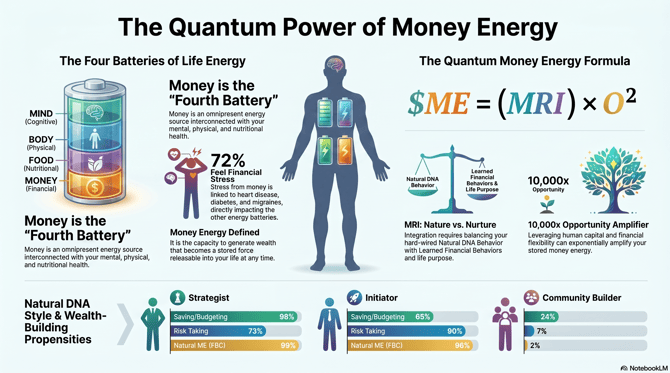
How Money Energy Works
DNA Behavior measures Money Energy using a behavioral formula inspired by Einstein's famous equation.
1. Natural Money Energy
Your Natural Money Energy (ME) reflects your natural motivation and ability to create wealth.
This is represented by your Financial Behavioral Capability (FBC) score.
According to the framework, these behavioral tendencies become largely established early in life and generally become most visible when you're under pressure.
Natural Financial Behavioral Capability includes three core behavioral drivers:
- Saving and Budgeting: Your natural discipline for managing and accumulating money.
- Goal Drive and Wealth Creation: Your motivation to pursue opportunities and build wealth.
- Risk Taking: Your instinctive willingness to take calculated financial and personal risks.
Together, these behaviors form the foundation of your natural financial potential.
2. Overall Money Energy
Natural behavior alone does not determine financial outcomes.
DNA Behavior defines Overall Money Energy using the following equation:
Overall Money Energy = (MRI) × O²
Where:
- MRI (Money Relationship Integration) measures how successfully you've integrated healthy money behaviors into your life.
- O (Opportunities) represents your ability to create financial opportunities through both financial flexibility and human capital.
Because Opportunities are squared within the equation, improvements in opportunity can dramatically increase your overall Money Energy.
Core Components
Financial Behavioral Capability (FBC)
Financial Behavioral Capability measures your natural financial behavior rather than learned financial knowledge.
It evaluates your instinctive approach to:
- Saving and budgeting
- Creating wealth through meaningful goals
- Taking financial risk
- Managing financial decisions under pressure
These behaviors form your baseline Money Energy.
Money Relationship Integration (MRI)
Money Relationship Integration represents the learned side of financial behavior.
While your natural tendencies remain relatively stable, your experiences, education, habits, and values influence how effectively you apply those tendencies.
A higher MRI indicates that money has become well integrated into your overall lifestyle and decision-making process.
Quality Life Performance (QLP)
Money Relationship Integration is influenced by Quality Life Performance (QLP), which evaluates balance across eight important areas of life:
- Life purpose
- Career
- Finances
- Relationships
- Health and recreation
- Community
- Confidence
- Wisdom
Strong performance across these areas supports healthier financial decision-making and long-term sustainability.
Opportunities
Opportunities act as the multiplier within the Money Energy model.
They consist of two major elements.
Financial Flexibility
Financial flexibility refers to having enough financial margin to make decisions without unnecessary pressure.
Examples include:
- Positive cash flow
- Surplus assets
- Emergency reserves
- A financial safety margin of approximately six to twelve months
Financial flexibility provides greater freedom to pursue opportunities rather than reacting to financial stress.
Human Capital
Human capital represents your ability to continue generating value throughout your lifetime.
This includes:
- Professional skills
- Personal talents
- Knowledge
- Relationships
- Experience
- Ongoing education and learning
Investing in human capital increases future earning potential while expanding available opportunities.
The Impact of Financial Stress
Money Energy is closely connected to financial stress.
Research referenced within the framework notes that approximately 72% of Americans experience financial stress. This stress has been associated with broader health concerns, including heart disease, diabetes, and depression.
The framework proposes an inverse relationship between Money Energy and financial stress.
As your Money Energy grows through stronger behavioral alignment, healthier money relationships, and greater opportunities, financial stress tends to decline.
Financial stress may also be reflected through changes in Heart Rate Variability (HRV), illustrating the connection between financial wellbeing and the body's nervous system.
The 40 Quantum Laws of Money Energy
DNA Behavior encourages individuals to strengthen their Money Energy by following a collection of guiding principles known as the 40 Quantum Laws of Money Energy.
Examples include:
Measure What Matters
Financial progress begins with measurement.
If you cannot measure your financial behaviors and outcomes, managing them becomes significantly more difficult.
Build Anti-Fragility
Rather than relying on a single source of wealth, develop multiple, independent sources of financial strength.
Diversification creates greater resilience during periods of uncertainty.
Align with Your Identity
Greater self-awareness allows you to make financial decisions that align with your natural behavioral strengths instead of constantly working against them.
Invest in Human Capital
Your knowledge, confidence, skills, and relationships continue generating value long after individual investments change.
Developing yourself remains one of the highest-return investments available.
How DNA Behavior Measures Money Energy
DNA Behavior identifies the behavioral patterns that influence Money Energy through two discovery methods.
| Assessment | Purpose |
|---|---|
| Natural Behavior Discovery Process | Provides approximately 97.1% behavioral measurement accuracy for detailed behavioral understanding. |
| AI Digital Scan | Provides approximately 75%–80% predictive accuracy for rapid behavioral insights. |
These assessments help identify:
- Financial behavior strengths
- Behavioral money derailers
- Cognitive biases
- Financial blind spots
Examples of behavioral biases include:
- Loss Aversion
- Overconfidence
Understanding these tendencies allows individuals to recognize behaviors that may reduce Money Energy before they affect long-term financial outcomes.
Why Money Energy Matters
Traditional financial measurements often focus on assets, income, or investment returns.
The Money Energy framework expands this view by recognizing that long-term wealth is influenced by both financial resources and behavioral capability.
By understanding your natural financial behavior, improving your relationship with money, strengthening your life balance, and expanding opportunities, you can build greater financial resilience and reduce unnecessary financial stress.
Money Energy isn't simply about accumulating wealth. It's about developing the behavioral capacity to create, preserve, and enjoy wealth throughout your life.
Summary
Money Energy combines behavioral science with financial capability to explain how wealth is created and sustained over time.
The framework brings together Financial Behavioral Capability, Money Relationship Integration, Quality Life Performance, and Opportunities into a single model that emphasizes both personal development and financial growth.
Understanding these components provides a practical way to recognize behavioral strengths, address financial blind spots, and build a more sustainable path toward long-term financial wellbeing.
For more information you can view this video.