![DNA-B-Primary_White (7).png]](https://kb.dnabehavior.com/hs-fs/hubfs/DNA-B-Primary_White%20(7).png?height=50&name=DNA-B-Primary_White%20(7).png)
Human Lifetime Economic Value (HLEV) is a forward-looking, human-centered framework that measures the total economic value a person can generate, preserve, and experience throughout their lifetime. Rather than focusing only on Assets Under Management (AUM), HLEV recognizes that long-term wealth is influenced by financial resources, behavioral patterns, health, longevity, and the quality of professional advice.
The HLEV model moves wealth management beyond portfolio performance by placing human behavior at the center of financial decision-making. It recognizes that the greatest opportunities for increasing lifetime wealth often come from improving how people make decisions, manage stress, and sustain healthy financial habits.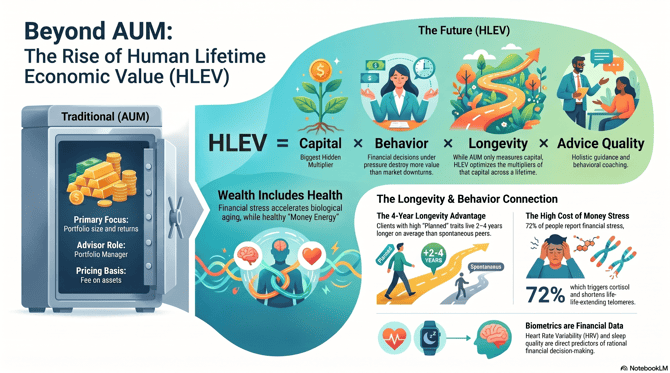
How HLEV Works
The HLEV framework is built around four interconnected variables that compound over time to influence a person's lifetime financial outcome.
1. Capital (C)
Capital represents the traditional financial foundation, including:
- Assets
- Income
- Savings
- Investments
While capital remains essential, it is only one component of lifetime economic value.
2. Behavior (B)
Behavior is the hidden multiplier within the HLEV model.
Financial discipline, emotional regulation, and consistent decision-making help wealth compound over time. Conversely, poor behavioral habits such as panic-selling, emotional investing, impulsive spending, or inconsistent planning can significantly reduce long-term wealth.
Behavior is treated as a multiplier rather than a standalone input because its effects accumulate throughout a person's financial life.
3. Longevity & Health (L)
Longevity determines how long wealth has to grow and how long it can support an individual's lifestyle.
Healthspan and cognitive performance influence:
- Financial decision quality
- Career productivity
- Investment discipline
- The duration of wealth accumulation
- The length of retirement planning
Longer, healthier lives extend the opportunity for wealth to compound.
4. Advice Quality (A)
Professional advice represents another compounding factor within HLEV.
High-quality advice creates measurable value through:
- Behavioral coaching
- Personalized planning
- Tax efficiency
- Better financial decision-making
- AI-assisted personalization
- Ongoing strategic guidance
Rather than simply managing investments, advisors help clients improve the decisions that determine lifetime outcomes.
The HLEV Formula
The simplified HLEV model is expressed as:
HLEV = Capital × Behavior × Longevity × Advice Quality
Each variable influences the others, creating either a positive or negative compounding effect over a person's lifetime.
Money Energy: The Behavioral Foundation
A central concept within HLEV is Money Energy.
Money Energy represents a person's capacity to generate, preserve, and release wealth throughout life. Within the DNA Behavior framework, money is considered the fourth primary life energy source alongside:
- Mind
- Body
- Food
- Money
Financial wellbeing is therefore viewed as both an economic and biological factor.
The Relationship Between Money and Stress
Financial stress affects much more than investment decisions.
Chronic money stress can:
- Activate the body's stress response
- Accelerate biological aging
- Reduce cognitive performance
- Increase the likelihood of health conditions such as cardiovascular disease
- Shorten the period during which wealth can be enjoyed
Improving a person's financial behaviors reduces stress, supports healthier aging, and extends the time available for wealth creation.
This creates a reinforcing cycle where better financial behavior supports better health, which in turn supports greater lifetime economic value.
Behavior and Longevity
One of the significant behavioral findings within the HLEV framework is the relationship between the Planned behavioral trait (Conscientiousness) and lifespan.
Individuals who score highly on the Planned trait typically:
- Follow health routines more consistently
- Manage stress more effectively
- Maintain stronger long-term habits
- Preserve cognitive performance later in life
Research supporting the HLEV model indicates that these individuals live, on average, two to four years longer than those with lower Planned scores.
Because of this relationship, behavioral data becomes an important input when estimating retirement duration and lifetime financial planning. A highly Planned client may require a significantly longer financial plan than traditional actuarial assumptions would suggest.
Consumer HLEV Index
At the individual level, HLEV is represented through a composite Consumer HLEV Index, combining financial, behavioral, and biological indicators.
| Component | Weight |
|---|---|
| Financial Health Score | 50% |
| Financial Behavior Score | 25% |
| Biometric Wellness Score | 25% |
Financial Health Score (50%)
Measures core financial strength, including:
- Cash flow
- Savings
- Debt management
Financial Behavior Score (25%)
Measures how consistently an individual makes sound financial decisions, including:
- Risk alignment
- Decision discipline
- Behavioral consistency
Biometric Wellness Score (25%)
Incorporates wearable technology and health indicators, such as:
- Heart Rate Variability (HRV)
- Sleep quality
- Stress indicators
These measures help predict both health trajectory and financial decision quality.
From AUM to HLEV
The wealth management industry is evolving through three distinct stages.
| Traditional AUM Firm | HLEV-Capable Firm |
| Measures assets gathered | Measures lifetime value created |
| Fee-on-assets pricing | Value-based or HLEV uplift pricing |
| Portfolio manager | Behavioral life coach |
| Valued primarily by AUM multiples | Valued by HLEV growth per client |
Under this model, the advisor's role expands beyond investment management to include behavioral coaching, long-term planning, and improving overall lifetime outcomes.
HelixBOS™: Operationalizing HLEV
Organizations implement HLEV using HelixBOS™, a Behavioral Intelligence Operating System that combines multiple streams of human data into a single decision-support framework.
The platform integrates:
Natural DNA Behavior
Measures hard-wired behavioral tendencies, including risk preferences and natural decision styles.
Learned Financial Behavior
Captures financial beliefs, habits, and experiences developed over time.
Real-Time Biometrics
Uses wearable health data to identify periods of elevated stress and provide timely behavioral guidance when individuals may be vulnerable to poor financial decisions.
Together, these components enable more personalized, proactive financial coaching throughout the client relationship.
Why HLEV Matters
Traditional wealth management measures success by the size of a client's portfolio.
HLEV measures something broader: the total lifetime value a person can create and experience.
By combining capital, behavior, health, longevity, and advice into one framework, HLEV helps advisors focus on improving the human factors that drive long-term financial outcomes. This creates stronger client relationships, more personalized guidance, and a planning approach designed around lifetime value rather than assets alone.
Summary
Human Lifetime Economic Value represents a shift from managing wealth to maximizing lifetime financial potential.
Instead of viewing wealth solely through investment balances, HLEV recognizes that lasting financial success depends on behavioral discipline, healthy longevity, and high-quality advice working together over time. The result is a more comprehensive framework for understanding, growing, and sustaining wealth throughout a person's life.