![DNA-B-Primary_White (7).png]](https://kb.dnabehavior.com/hs-fs/hubfs/DNA-B-Primary_White%20(7).png?height=50&name=DNA-B-Primary_White%20(7).png)
High Stakes Decision Advisory is a specialized executive advisory service designed to help CEOs, boards, investors, and senior decision-makers maintain clear thinking during major adversarial events, particularly disputes involving claims or potential losses exceeding $25 million.
While organizations typically rely on legal counsel for legal strategy and crisis communications teams for public messaging, an important gap often remains: independent strategic support for the executive responsible for making the final decisions.
This advisory focuses on strengthening executive judgment under pressure. It helps leaders recognize behavioral biases, manage psychological stress, and make disciplined decisions that support long-term business objectives rather than emotional reactions.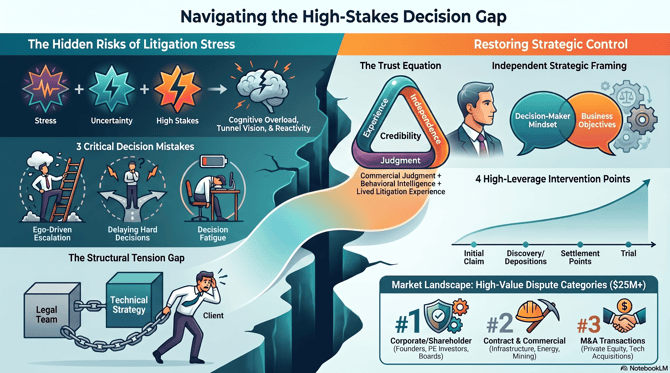
How High Stakes Decision Advisory Works
1. Independent Strategic Perspective
The advisory provides an independent layer of strategic thinking that complements, rather than replaces, legal advisors, litigation teams, and crisis communication specialists.
Its purpose is to help executives:
- Maintain objectivity throughout the dispute.
- Separate business priorities from emotional responses.
- Evaluate options through a strategic rather than reactive lens.
- Keep legal strategy aligned with broader organizational goals.
2. Behavioral Decision Support
Major disputes place executives under sustained psychological pressure. The advisory identifies behavioral patterns that can impair judgment and provides practical guidance to help leaders make balanced, evidence-based decisions.
3. Executive Performance Coaching
As disputes progress, executives receive ongoing support to prepare for difficult conversations, regulatory interactions, depositions, and critical strategic decisions while maintaining confidence and discipline.
The Six Critical Decision-Making Mistakes
Executives involved in high-value litigation often encounter predictable decision traps that negatively affect outcomes.
Escalation Driven by Ego or Identity
Business decisions can become personal. Leaders may reject practical settlement opportunities because they view compromise as admitting fault or weakening their authority.
Misjudging Litigation Risk
Optimism bias can lead executives to believe the facts are overwhelmingly in their favor or that the opposing party will eventually concede, resulting in unrealistic expectations.
Delaying Difficult Decisions
Waiting for problems to resolve naturally often reduces strategic flexibility. Decisions such as settlement, restructuring, or operational adjustments become more difficult as disputes continue.
Treating Litigation Like Commercial Negotiation
Traditional negotiation tactics do not always translate effectively into litigation. Court procedures, evidentiary standards, and judicial interpretation require a different decision-making approach.
Poor Testimony Preparation
Executives sometimes approach testimony as a debate to be won rather than a disciplined communication exercise. Successful testimony depends on precision, consistency, and emotional control.
Decision Fatigue
Extended legal disputes can last several years. Continuous stress gradually reduces decision quality, increasing the likelihood of inconsistent strategy or poor late-stage judgment.
The Eight Psychological Breaking Points
High-value disputes are often multi-year events that challenge executive resilience. Eight stages consistently place additional pressure on leadership judgment.
1. Initial Shock
The transition from emotional reaction to strategic containment immediately following a claim or major dispute.
2. Reputation Fear
Managing concerns about public perception, stakeholder confidence, board expectations, and investor trust.
3. Discovery Exhaustion
Responding to extensive document reviews, electronic discovery, and detailed examination of internal communications while maintaining focus.
4. Mounting Cost Realization
Recognizing the growing financial and operational costs of litigation without allowing sunk-cost bias to influence future decisions.
5. Testimony Anxiety
Preparing for depositions, regulatory interviews, and cross-examinations by emphasizing disciplined communication instead of argument.
6. Settlement Dilemma
Balancing the emotional desire to "win" against the practical value of achieving a strategically beneficial resolution.
7. Trial Proximity Stress
Maintaining disciplined leadership as pressure increases and attention shifts toward trial preparation and courtroom performance.
8. Leadership Reset
Recovering from the psychological demands of prolonged disputes while restoring strategic focus for the business and its leadership team.
Core Service Modules
Strategic Situation Assessment
Conducted early in the dispute to evaluate strategic exposure, identify behavioral risks, and establish a clear decision framework before legal strategies become fixed.
Executive Decision Advisory
Provides continuous support throughout the dispute, helping executives remain the primary strategic decision-maker while ensuring legal activities support broader business objectives.
Adversarial Performance Preparation
Prepares executives for high-pressure interactions, including depositions, regulatory interviews, hearings, and cross-examinations through behavioral and psychological preparation.
Strategic Resolution Advisory
Offers independent evaluation of settlement opportunities, litigation risks, and trial scenarios to distinguish rational business outcomes from emotionally driven decisions.
Leadership Reset
Supports executives after major disputes by addressing psychological fatigue, rebuilding resilience, and restoring strategic leadership capacity.
Why Demand Is Increasing
Several global trends are increasing the need for independent executive decision advisory.
Weaponization of Law
Litigation is increasingly used as a competitive strategy to influence markets, delay competitors, or reshape industry dynamics.
Growing Complexity
Modern litigation involves extensive electronic discovery, technical legal procedures, and highly specialized expertise that can distance executives from the decision-making process.
Stronger Governance Expectations
Boards and investors increasingly expect independent oversight and disciplined strategic decision-making during significant legal disputes.
Greater Personal Exposure
Directors and senior executives face increasing personal liability in shareholder actions, regulatory investigations, and governance matters.
Human Judgment in an AI Environment
Artificial intelligence can rapidly analyze documents and identify patterns, but it cannot replace executive judgment, manage adversarial relationships, or navigate the psychology of high-pressure leadership decisions.
Engagement Model
High Stakes Decision Advisory operates as a high-trust, limited-capacity service, typically supporting between five and ten clients at any given time.
Engagements generally begin through trusted referrals from senior litigators, board members, investors, crisis communication advisors, or other professional networks when an executive requires independent strategic support during an exceptionally demanding situation.
This approach allows for highly personalized guidance throughout the lifecycle of a dispute while maintaining confidentiality, strategic focus, and sustained executive support.
Why It Matters
Major disputes are rarely decided by legal arguments alone. They are influenced by the quality of executive judgment throughout the process.
High Stakes Decision Advisory helps leaders remain disciplined when emotions, uncertainty, financial exposure, and prolonged pressure threaten objective decision-making. Rather than replacing legal expertise, it strengthens the executive's ability to make clear, rational, and strategically aligned decisions at every stage of the dispute.
Summary
High Stakes Decision Advisory provides independent strategic and behavioral guidance for leaders navigating complex, high-value disputes. By addressing the psychological challenges that accompany major litigation, it helps executives maintain clarity, improve decision quality, and protect long-term organizational interests throughout the entire dispute lifecycle.
For more information you can view this video.