![DNA-B-Primary_White (7).png]](https://kb.dnabehavior.com/hs-fs/hubfs/DNA-B-Primary_White%20(7).png?height=50&name=DNA-B-Primary_White%20(7).png)
The DNA Behavior® Forced Choice Scoring Model is the methodology used to measure an individual's Natural DNA Behavior—the stable, hard-wired behavioral traits that shape how they think, communicate, make decisions, and respond under pressure.
Unlike traditional personality assessments that rely on rating scales, the Forced Choice model is designed to reveal enduring behavioral instincts rather than temporary preferences or learned behaviors. Its goal is to minimize common assessment biases and provide a more stable and predictable view of natural behavior.
Research supporting the DNA Behavior framework indicates that up to 95% of subconscious behavioral programming is established by approximately age seven. Although people adapt to different environments throughout life, they generally return to their natural behavioral patterns when experiencing stress or pressure. The Forced Choice methodology is specifically designed to measure these underlying patterns.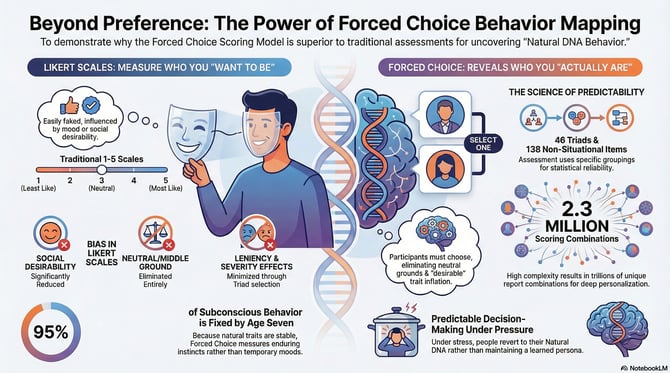
How the Forced Choice Model Works
1. Measuring Natural Behavior
The assessment focuses on natural, non-situational behavior rather than asking how someone behaves in a particular circumstance.
Instead of measuring temporary preferences, it identifies the behavioral tendencies that remain consistent across different environments and become most visible during times of stress.
2. Triad-Based Questions
Participants are presented with groups of three individual words or short phrases, known as triads.
For each triad, they must make two decisions:
- Select the item that is Most Like them.
- Select the item that is Least Like them.
One item within each triad is intentionally left unscored, allowing the assessment to gather more accurate behavioral information without encouraging response inflation.
3. Forced Decision Making
Unlike traditional questionnaires, there is no neutral option.
Every response requires participants to prioritize one characteristic over another, making it much more difficult to select every desirable trait equally.
This approach helps reveal instinctive behavior instead of aspirational self-perception.
Why Traditional Rating Scales Fall Short
Many personality assessments use a Likert scale, where participants rate statements using a numerical scale such as 1 to 5.
While simple to complete, this approach introduces several well-known limitations.
| Traditional Likert Scale | DNA Behavior® Forced Choice Model |
|---|---|
| Allows participants to rate many traits equally high | Requires participants to prioritize between traits |
| More susceptible to social desirability bias | Reduces the opportunity to inflate desirable characteristics |
| Influenced by current mood and environment | Designed to measure stable natural behavior |
| Easier to intentionally or unintentionally manipulate | Makes "faking" significantly more difficult |
| Scores may drift over time | Produces more stable behavioral measurements |
Traditional rating systems commonly experience:
- Social desirability bias: People often answer based on who they would like to be rather than who they naturally are.
- Environmental influence: Current circumstances, education, workplace culture, or emotional state can affect responses.
- Faking and score drift: Results can be consciously manipulated or gradually change despite natural behavior remaining relatively constant.
- Inflated scoring: Research indicates respondents generally score higher using traditional rating formats than they do with forced-choice assessments.
The Forced Choice methodology was specifically developed to reduce these issues.
Technical Foundation of the Assessment
The DNA Behavior® Discovery assessment is built using a comprehensive psychometric framework designed to produce statistically reliable measurements.
The assessment includes:
- 46 behavioral triads
- 138 non-situational rating items
- Measurement across 8 primary behavioral factors
- Analysis of 24 behavioral sub-factors
- More than 20 supporting items for every measured factor
- Over 2.3 million scoring combinations
- Trillions of possible report variations
The methodology has also been independently validated and has been used by more than 3.25 million participants worldwide.
This depth of measurement allows the assessment to move beyond broad personality categories and produce detailed behavioral insights.
What the Assessment Reveals
The Forced Choice model is designed to identify how people naturally behave, particularly when facing pressure or uncertainty.
You gain insight into:
- Natural decision-making tendencies
- Communication preferences
- Behavioral strengths
- Predictable blind spots
- Responses to pressure
- Long-term behavioral consistency
Because people typically become more like themselves under stress—not someone different—the assessment provides highly predictable insight into future behavior.
Common Applications
Hiring and Talent Selection
Organizations can identify natural behavioral strengths rather than relying solely on interview performance or self-reported preferences.
Leadership Development
Leaders gain a better understanding of their own behavioral style and how it influences communication, delegation, and decision-making.
Team Alignment
Behavioral differences become visible before they create misunderstanding, allowing teams to improve collaboration and reduce unnecessary friction.
Conflict Prevention
The assessment highlights predictable areas where communication styles or behavioral preferences may clash, making it easier to address issues proactively.
Decision-Making
Understanding natural behavioral tendencies helps predict how individuals or clients are likely to evaluate options, respond to pressure, and make important decisions.
Relationship Building
Recognizing another person's natural communication style helps establish stronger trust and more effective long-term relationships.
Why the Forced Choice Model Matters
Many assessments measure how people describe themselves.
The DNA Behavior® Forced Choice Scoring Model is designed to measure how people naturally behave.
By removing neutral responses and reducing opportunities for response inflation, the methodology produces a more stable representation of Natural DNA Behavior. The result is behavioral data that remains useful across leadership, hiring, coaching, relationship development, and decision-making applications.
Rather than measuring temporary preferences, it focuses on the instincts that remain consistent throughout life and become most evident when individuals are under pressure.
Summary
The DNA Behavior® Forced Choice Scoring Model provides a scientifically structured approach to measuring Natural DNA Behavior.
Instead of relying on traditional rating scales, participants make deliberate "Most Like" and "Least Like" selections within carefully designed triads. This process reduces common assessment biases and improves the stability and reliability of behavioral measurement.
The result is an accurate and predictable map of an individual's natural behavioral tendencies that can be applied across hiring, leadership, coaching, teamwork, relationship building, and decision-making.
Video guide: A companion video is available for this topic and provides a visual walkthrough of the Forced Choice Behavior Mapping methodology.