![DNA-B-Primary_White (7).png]](https://kb.dnabehavior.com/hs-fs/hubfs/DNA-B-Primary_White%20(7).png?height=50&name=DNA-B-Primary_White%20(7).png)
Family offices operate in an environment where preserving wealth is only part of the challenge. Long-term success also depends on how family members communicate, make decisions, resolve conflict, and prepare future generations for leadership.
The DNA Behavior Family Office Behavioral Intelligence Proposal introduces a behavioral intelligence framework that helps advisors understand the human dynamics behind wealth management. Rather than focusing only on financial portfolios and legal structures, it provides insight into the behavioral patterns that influence governance, succession, trust, and family relationships.
The platform shifts the conversation from analyzing historical financial data ("Quanta") to understanding the unique behavioral characteristics, communication preferences, and emotional drivers ("Qualia") that shape family decisions.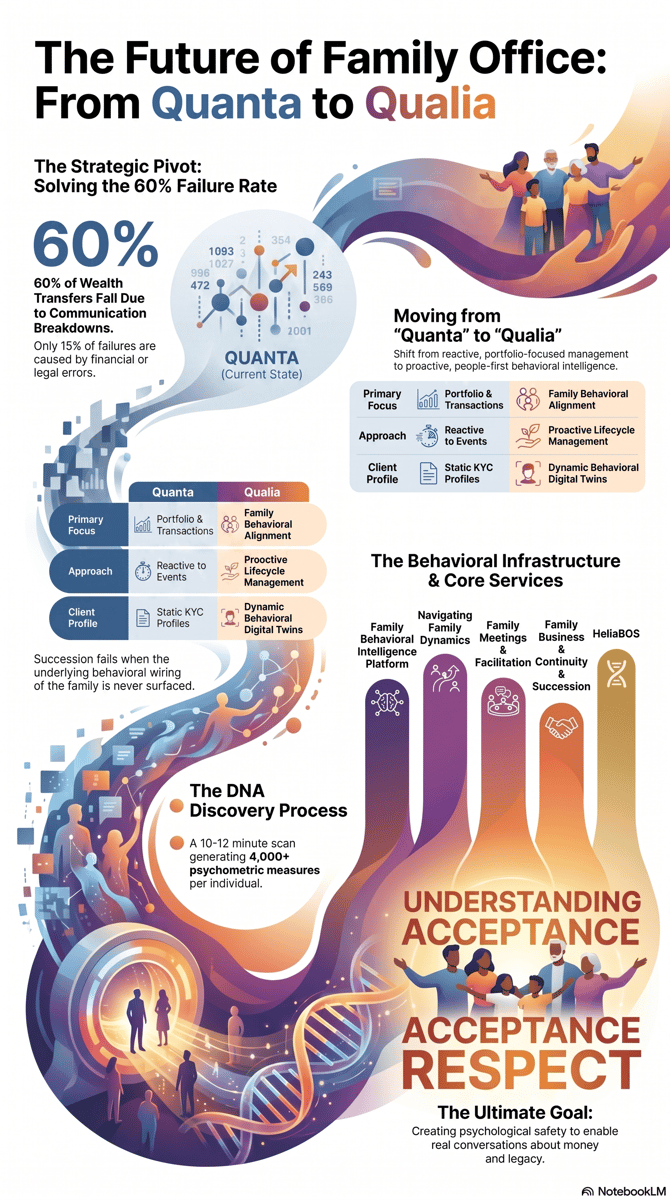
Why Behavioral Intelligence Matters
Research consistently shows that the greatest threats to successful wealth transfer are behavioral rather than financial.
Family wealth transfer failures are primarily driven by:
- Communication breakdowns between family members.
- Loss of trust across generations.
- Inadequately prepared heirs.
- Unresolved behavioral differences.
- Founder identity challenges and difficulty transitioning leadership.
According to the proposal:
- Approximately 60% of wealth transfer failures result from communication and trust issues.
- Around 25% stem from heirs who are not adequately prepared.
- Less than 15% are caused by financial or legal problems.
This highlights that even well-designed financial and legal plans can fail when underlying family dynamics remain unresolved.
How the DNA Discovery Process Works
The foundation of the platform is a validated behavioral assessment called the DNA Full Scan.
1. Complete the Assessment
Each participating family member completes a behavioral assessment that typically takes 10–12 minutes.
2. Generate Behavioral Intelligence
The assessment produces more than 4,000 psychometric measurements for every individual, providing insight into:
- Natural decision-making patterns.
- Financial behavior.
- Communication preferences.
- Emotional triggers.
- Behavioral strengths.
- Potential areas of conflict.
3. Build Family Intelligence
Individual profiles are combined into family reports that allow advisors and family members to understand relationships across the entire family system.
4. Digital Scan Option
When direct participation is not immediately possible, a Digital Scan can be completed in batches as an alternative starting point for initial engagements.
Core Service Areas
The platform provides a modular set of services that address the primary challenges faced by family offices.
Family Behavioral Intelligence Platform
This forms the behavioral data layer for the family office.
You gain:
- Individual DNA Natural Behavior profiles.
- Family Group Reports.
- Side-by-side behavioral comparisons.
- Objective discussions around behavioral differences.
- A psychologically safe foundation for family conversations.
Navigating Family Dynamics
Behavioral intelligence helps improve communication between family members and advisors.
This includes:
- Mapping communication styles.
- Understanding direct versus relationship-focused communication.
- Matching family members with advisors whose communication styles complement their own.
- Reducing misunderstandings before they escalate.
Family Meetings and Facilitation
Family meetings often become unbalanced because more assertive personalities naturally dominate discussions.
DNA-informed facilitation helps:
- Ensure every family member has an opportunity to contribute.
- Balance participation across different personality styles.
- Improve decision quality.
- Create productive conversations around difficult topics.
Independent facilitation can also protect the primary advisor relationship when discussions involve emotionally sensitive issues.
Family Business Continuity and Succession
Behavioral intelligence adds an important dimension to succession planning by focusing on leadership readiness rather than only ownership structures.
Capabilities include:
- Successor Readiness Scoring.
- Behavioral competency mapping.
- Leadership role alignment.
- Founder transition support.
- Identification of Decisioning Digital Twins for family members.
This helps move succession planning from theoretical documentation to practical execution.
HelixBOS (Behavioral Operating System)
HelixBOS serves as the behavioral intelligence engine behind the advisor's workflow.
It includes an AI Co-Pilot that can assist with:
- Personalized communication recommendations.
- Conversation preparation.
- Advisor guidance.
- Next-best conversation suggestions.
- Behavioral insights integrated into daily client management.
The Foundation: Understanding, Acceptance, and Respect
The methodology is designed to create psychological safety through objective behavioral understanding.
Instead of judging differences, family members gain a shared understanding of how each person naturally communicates, makes decisions, and approaches financial matters.
This creates an environment where conversations about wealth, governance, succession, and legacy become more productive because behavioral differences are understood rather than misunderstood.
The goal is not to change personalities. It's to help people work together more effectively.
Business Impact for Family Offices
Adopting a behaviorally intelligent operating model provides measurable benefits across advisory practices.
Advisor Productivity
Advisors can recover approximately 12–18 hours per week by reducing administrative effort and improving the efficiency of client interactions.
Stronger Client Relationships
Behavioral intelligence shifts advisor relationships from transaction-focused engagements to trust-based, multi-generational partnerships.
Improved Succession Outcomes
Families move from succession plans that are technically complete but behaviorally stalled to transitions that are intentionally aligned and more likely to succeed.
Better Governance
Behavioral transparency supports stronger governance by improving communication, reducing conflict, and helping family members make decisions with greater confidence.
Implementation Roadmap
A typical engagement follows five structured phases.
1. Strategy and Discovery
Leadership aligns on objectives and identifies families that will benefit most from behavioral intelligence.
2. Pilot Family Profiling
A live family case demonstrates the value of behavioral insights using real-world family dynamics.
3. Advisor Enablement
Advisors receive training on the DNAB Web App and Gene AI to generate personalized communication guidance and behavioral recommendations.
4. Platform Scoping
Existing CRM and technology infrastructure are evaluated to determine integration opportunities for HelixBOS.
5. Ongoing Partnership
Family offices continue to receive platform access, advisor support, behavioral facilitation, and guidance for significant family meetings and succession events.
Why It Matters
Financial structures help preserve wealth.
Behavioral intelligence helps preserve families.
By understanding how people naturally think, communicate, and make decisions, family offices can reduce conflict, improve governance, strengthen advisor relationships, and support successful wealth transitions across multiple generations.
That is the foundation of long-term family continuity.
For more information you can view this video.