![DNA-B-Primary_White (7).png]](https://kb.dnabehavior.com/hs-fs/hubfs/DNA-B-Primary_White%20(7).png?height=50&name=DNA-B-Primary_White%20(7).png)
The DNA Natural Behavior Discovery Process (the "Discovery") is a psychometric personality inventory introduced in 2009 to measure a person's natural, enduring behavioral traits. It serves as the foundation for both Business DNA® and Financial DNA® services.
The purpose of the Discovery is simple: to distinguish who a person naturally is from who they have learned to become. By making invisible behavioral patterns visible, it provides a deeper understanding of how people think, communicate, react under pressure, and make important decisions.
Most people only see a small portion of behavior on the surface. The Discovery helps reveal the underlying patterns that drive actions, choices, and performance.
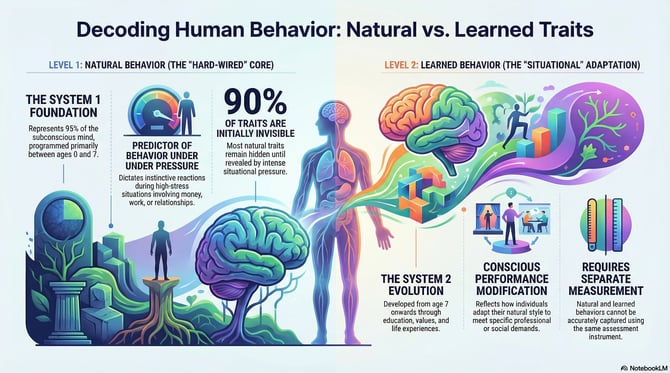
How Human Behavior Is Structured
The DNA Behavior framework separates behavior into two distinct levels:
1. Natural Behavior
Natural behavior represents a person's core behavioral DNA. It is considered non-situational and remains remarkably stable throughout life.
These traits begin developing between conception and age three as neural pathways are formed through genetics and early experiences. By age five, approximately 85% of these patterns have been established. By age seven, up to 95% of the subconscious mind has been programmed.
Natural behavior aligns with what behavioral science often refers to as System 1 thinking—fast, instinctive, automatic, and enduring.
Because these traits operate largely below conscious awareness, they are often difficult to observe directly.
2. Learned Behavior
Learned behavior represents the adaptations, preferences, and conscious choices people develop over time.
This level of behavior begins developing from approximately age seven onward and continues throughout life. A particularly important development period occurs between ages seven and fifteen.
Learned behavior aligns with System 2 thinking—deliberate, conscious, and influenced by education, beliefs, values, experiences, and environment.
Unlike natural behavior, learned behavior is flexible and can be intentionally developed and refined.
The Invisible Side of Behavior
One of the most important concepts in the Discovery framework is that much of human behavior is not immediately visible.
According to the model, approximately 90% of a person's natural behavior remains hidden during normal interactions.
These deeper patterns often emerge when individuals experience pressure, uncertainty, conflict, financial stress, or relationship challenges.
Common triggers include:
- Financial decisions
- Relationship issues
- Workplace pressure
- Deadlines and performance expectations
- Major life changes
When pressure increases, natural behavior becomes more visible and often intensifies.
That's why understanding natural behavior provides valuable insight into how someone is likely to respond when circumstances become challenging.
What Happens Under Pressure
People can learn behaviors that help them succeed in specific environments. However, under significant stress, many individuals naturally revert to their core behavioral tendencies.
The Discovery framework helps explain why this happens.
Organization Example
A naturally spontaneous individual may learn strong organizational habits to meet workplace expectations.
Under normal conditions, they may appear highly structured and disciplined.
When faced with multiple competing deadlines or significant stress, however, they may struggle to maintain that structure and return to their naturally spontaneous style.
Compassion Example
A naturally task-focused person may learn strong relationship-building skills and demonstrate warmth and empathy in everyday interactions.
Under pressure, they may become more focused on logic, efficiency, and outcomes, causing their relational style to become less visible.
These shifts are not personality changes. They are examples of learned behaviors giving way to natural tendencies when pressure increases.
How the Discovery Process Works
DNA Behavior believes that natural and learned behaviors cannot be accurately measured using the same assessment.
For that reason, the Discovery focuses specifically on measuring natural behavior.
To create a complete picture of an individual, the Discovery is often combined with separate learned-behavior assessments.
This dual-assessment approach helps identify:
- Natural strengths
- Learned adaptations
- Areas of alignment
- Potential sources of stress
- Development opportunities
- Performance challenges
By understanding both dimensions, leaders, advisors, coaches, and individuals gain a more complete view of behavior and performance.
Targeted Performance Assessments
Beyond the Natural Behavior Discovery, DNA Behavior offers 14 specialized learned-behavior discovery processes designed for specific performance areas.
These assessments can be applied to areas such as:
- Leadership development
- Sales effectiveness
- Entrepreneurship
- Workplace performance
- Team collaboration
- Professional growth
Each assessment focuses on how learned behaviors influence success within a particular environment or role.
When to Use the Discovery
The Discovery is useful whenever understanding behavior can improve outcomes.
Common applications include:
Personal Development
- Increase self-awareness
- Understand strengths and challenges
- Improve decision-making
Leadership
- Manage people more effectively
- Improve communication
- Build stronger teams
Business Relationships
- Understand behavioral differences
- Reduce misunderstandings
- Strengthen collaboration
Financial Decision-Making
- Recognize behavioral influences on money decisions
- Improve planning conversations
- Understand risk and decision preferences
Why It Matters
Most people evaluate behavior based on what they can see.
The challenge is that visible behavior often reflects learned adaptations rather than natural tendencies.
The Discovery helps uncover the behavioral patterns that drive actions beneath the surface. Because natural behavior forms the foundation of how people think, react, and make decisions, it provides a more reliable view of future behavior than observation alone.
This is not about putting people into boxes.
It's about understanding how they naturally operate so they can build on strengths, manage challenges, and perform more effectively in the situations that matter most.
Summary
The DNA Natural Behavior Discovery Process measures the natural behavioral traits that form the foundation of human behavior.
It distinguishes natural behavior from learned behavior, explains how people respond under pressure, and provides insight into the hidden patterns that influence decisions, relationships, and performance.
When both natural and learned behaviors are understood together, individuals and organizations can make better decisions, communicate more effectively, and achieve stronger outcomes.
For more information you can view this video.