![DNA-B-Primary_White (7).png]](https://kb.dnabehavior.com/hs-fs/hubfs/DNA-B-Primary_White%20(7).png?height=50&name=DNA-B-Primary_White%20(7).png)
Healthy teams and families are built on more than shared goals. They depend on understanding how people naturally think, communicate, make decisions, and contribute to the group.
DNA Behavior Analysis provides leaders, coaches, advisors, and families with a structured way to identify these natural behavioral patterns. Instead of relying on assumptions or observations alone, it helps uncover the underlying talents and tendencies that influence performance, relationships, and decision-making.
When people understand themselves and each other better, communication improves, trust grows, and collaboration becomes more effective.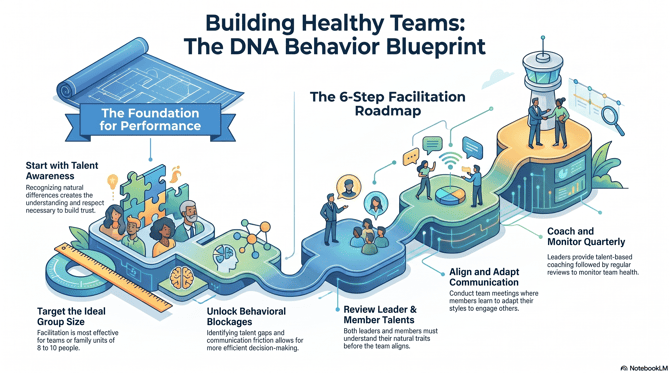
How the Team and Family Performance Model Works
The DNA Behavior approach follows a progression that helps groups move from awareness to long-term success.
1. Recognizing Talents
The first step is identifying the natural strengths and behavioral talents of each individual.
Every person brings unique abilities, communication preferences, and decision-making styles. Understanding these differences creates the foundation for effective collaboration.
2. Understanding and Acceptance
Once talents are recognized, team members and family members gain a clearer understanding of one another.
This creates greater respect, reduces misunderstandings, and improves communication across the group.
3. Trust and Alignment
As understanding increases, trust develops more naturally.
Individuals become more willing to support shared goals and work together toward common outcomes.
4. Overall Success
When talents are understood, communication is effective, and trust is established, the group becomes more connected and productive.
This leads to healthier relationships, better decisions, and stronger long-term performance.
The Six-Step Implementation Roadmap
Building a healthy team or family is an ongoing process. DNA Behavior recommends a six-step approach.
1. Leader Review
The leader begins by identifying their own natural behavioral talents and reviewing current challenges affecting the group.
This creates greater self-awareness and helps improve decision-making.
2. Team Member Review
Each participant completes their own review to discover their natural talents and understand how they contribute to the group.
3. Team Meeting
The group comes together to discuss insights and align around shared objectives, expectations, and productivity goals.
4. Team Relationships
Members learn how to adapt their communication styles to engage more effectively with different personalities and behavioral preferences.
5. Leader Coaching
Using behavioral insights, leaders can coach each individual according to their natural strengths rather than using a one-size-fits-all approach.
6. Team Monitoring
Quarterly reviews help ensure the group remains healthy, aligned, and focused on continuous improvement.
Facilitating a Team or Family Event
DNA Behavior insights are often used during dedicated workshops, team-building sessions, leadership events, and family development programs.
Preparation
Before the event, participants complete:
- DNA Natural Behavior Discovery Process
- Team Performance Score Card
The recommended group size is between 8 and 10 participants.
Required Materials
Each participant should have access to:
- Individual Report
- Team Report
- Unlocking Guide
- DNA Team Performance Plan
Pre-Session Meetings
Facilitators should meet with both the leader and individual participants before the event.
These discussions help identify:
- Current challenges
- Team objectives
- Individual strengths
- Areas of concern
- Opportunities for growth
The leader should also be prepared to openly discuss challenges and opportunities within the group.
Event Structure
A typical event may include:
- Ice-breaker activities
- Team Performance Plan exercises
- Communication improvement discussions
- Leadership development activities
- Succession planning conversations
- Team effectiveness frameworks such as the Five Dysfunctions model
Understanding the Team Report
The Team Report serves as the central tool for evaluating group dynamics and identifying opportunities for improvement.
Identity and Purpose
The report helps determine:
- The team's mission
- The group's purpose
- Whether collective talents align with desired outcomes
Style Distribution
The report identifies:
- Individual DNA Natural Behavior Styles
- Balance between relationship-focused and results-focused behaviors
- Areas of behavioral concentration or imbalance
Talent Gap Analysis
Understanding collective strengths also reveals potential gaps.
The report helps identify:
- Missing talents
- Potential blind spots
- Areas where additional support may be required
Growth and Stability
The analysis highlights behavioral blockages that may limit performance and identifies actions that can help the group achieve its goals.
Communication Keys
Each member can identify:
- Personal strengths
- Common struggles
- Preferred communication methods
- Specific ways others can work more effectively with them
You get practical guidance that can be applied immediately.
Gaining Leadership Buy-In
Successful implementation begins with leadership commitment.
Before launching a team or family initiative, facilitators should conduct a dedicated discussion with the leader to explore:
- Current business or family challenges
- Management concerns
- Leadership style
- Concerns regarding specific individuals
- Long-term goals
- Desired outcomes for the program
An important part of this process is identifying any disconnect between a leader's perception of an individual and that person's actual DNA Behavior results.
Addressing these differences early helps create more objective and effective leadership decisions.
Why DNA Behavior Analysis Matters
Many teams and families struggle because they focus on visible behaviors without understanding the underlying drivers behind them.
DNA Behavior Analysis provides a framework for understanding those drivers.
You gain:
- Greater self-awareness
- Better communication
- Stronger trust
- More effective coaching
- Improved decision-making
- Clearer role alignment
- Healthier relationships
This is not about changing who people are.
It's about understanding how people naturally operate so they can work together more effectively.
When behavioral strengths are recognized and respected, groups become more connected, resilient, and successful.
Further Reading
For a deeper understanding of the science and methodology behind this approach, refer to:
Leadership Behavior DNA by Lee Ellis and Hugh Massie.