![DNA-B-Primary_White (7).png]](https://kb.dnabehavior.com/hs-fs/hubfs/DNA-B-Primary_White%20(7).png?height=50&name=DNA-B-Primary_White%20(7).png)
Behavioral variability is one of the most significant yet often overlooked challenges in professional decision-making. It occurs when different people reach different conclusions despite having access to the same information.
This variability creates inconsistency, reduces decision quality, and introduces hidden risks across organizations. Whether in financial advice, hiring, investing, healthcare, or leadership decisions, behavioral variability can undermine outcomes without decision-makers even realizing it.
At its core, behavioral variability consists of two separate sources of error: bias and noise.
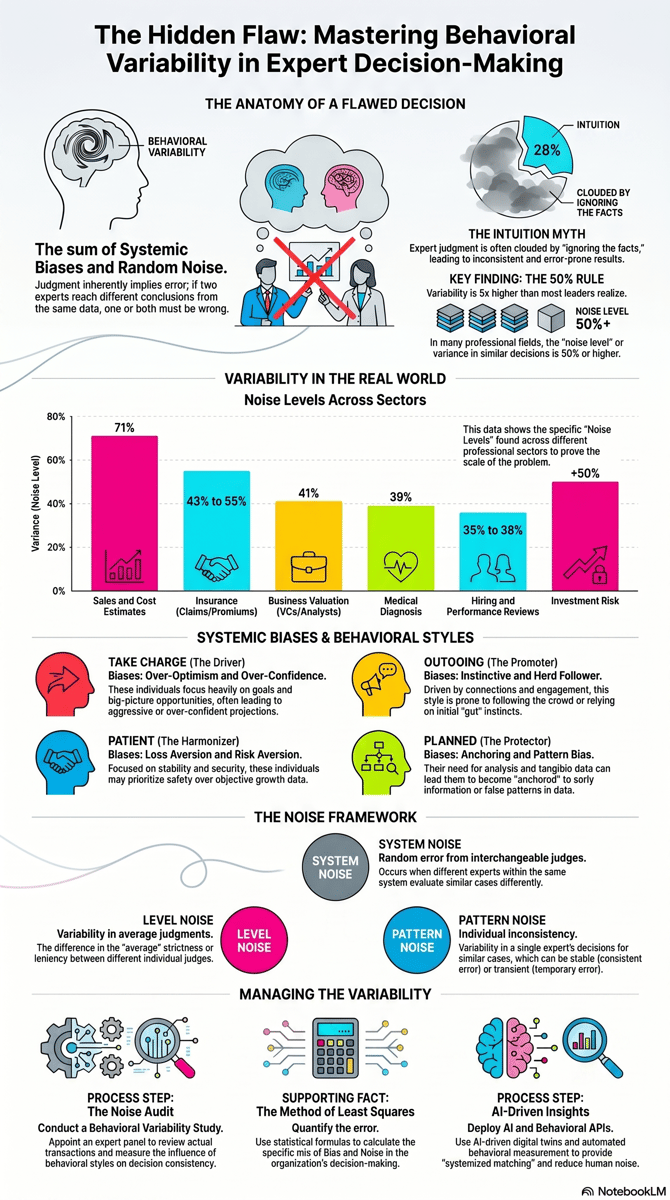
Understanding Decision Error
Decision error is not caused by a single factor. It is the combined result of two distinct forces that influence judgment.
1. Systemic Bias
Bias represents a predictable deviation from objective judgment.
It consistently pushes decisions in a particular direction. For example, an advisor may repeatedly underestimate risk, while another may consistently overestimate future opportunities.
Because bias follows a recognizable pattern, it can often be identified and measured over time.
2. Noise
Noise is different.
Rather than creating a consistent directional error, noise introduces random variation into decisions that should ideally be the same.
Two professionals reviewing identical information may reach entirely different conclusions. The inconsistency itself becomes the problem.
While bias tilts decisions, noise scatters them.
Together, they create total decision error.
How Behavioral Styles Influence Bias
DNA Behavior identifies distinct behavioral styles that naturally influence how people process information and make decisions. Each style carries strengths, but each can also introduce predictable biases.
Take Charge (Driver)
Take Charge individuals focus on goals, opportunities, and forward momentum.
Common biases include:
- Over-optimism
- Over-confidence
- Underestimating obstacles
- Excessive belief in positive outcomes
Outgoing (Promoter)
Outgoing individuals are energized by people, relationships, and engagement.
Common biases include:
- Instinctive decision-making
- Herd follower tendencies
- Social influence bias
- Overreliance on consensus
Patient (Harmonizer)
Patient individuals value stability, security, and consistency.
Common biases include:
- Loss aversion
- Risk aversion
- Resistance to change
- Preference for familiar solutions
Planned (Protector)
Planned individuals rely heavily on structure, analysis, and evidence.
Common biases include:
- Anchoring bias
- Pattern recognition bias
- Over-analysis
- Excessive reliance on initial information
These biases are not flaws. They are natural tendencies that influence how people interpret situations and make judgments.
Understanding them allows organizations to make better decisions while reducing blind spots.
The Three Types of Noise
Noise is not a single phenomenon. It appears in several forms that affect decision consistency across organizations.
1. System Noise
System noise occurs when multiple people performing the same role make significantly different decisions under similar circumstances.
Examples include:
- Insurance claims evaluations
- Lending decisions
- Performance reviews
- Compliance assessments
Ideally, interchangeable professionals should produce similar outcomes. System noise creates unnecessary variation.
2. Level Noise
Level noise occurs when different decision-makers consistently operate at different judgment levels.
For example:
- One manager consistently rates employees higher than average.
- Another consistently rates employees lower than average.
The difference is not caused by employee performance but by the evaluator's judgment standard.
3. Pattern Noise
Pattern noise occurs when an individual's decisions vary across similar situations.
This can appear as:
- Stable pattern noise, caused by consistent personal quirks
- Transient pattern noise, caused by temporary influences such as fatigue, stress, mood, or environmental factors
Pattern noise often remains invisible because individuals assume their decisions are objective and consistent.
The Statistical Reality of Decision Variability
Research shows that variability in professional judgment is far greater than most leaders expect.
Observed noise levels include:
| Decision Area | Typical Variability |
|---|---|
| Sales and Cost Estimates | 71% |
| Investment Risk Assessment | Over 50% |
| Medical Diagnosis | 39% |
| Hiring Decisions | 35%–38% |
| Performance Reviews | 35%–38% |
These figures demonstrate that inconsistency is not an isolated issue. It exists across industries and functions.
Another important finding involves intuition.
Although intuition plays a role in professional judgment, studies suggest its accuracy is approximately 28% when unsupported by facts and structured analysis.
This doesn't mean intuition has no value. It means intuition alone often introduces unnecessary variability.
Psychological Drivers of Variability
Several human factors increase both bias and noise.
The Energy of Money
An individual's personal experiences, beliefs, and emotional relationship with money can influence professional judgment.
Past successes, failures, fears, and motivations can unconsciously shape recommendations and decisions.
Amygdala Hijack
When people experience stress, uncertainty, or perceived threats, emotional responses can override rational thinking.
This phenomenon, often called an amygdala hijack, can lead to reactive decisions that differ significantly from decisions made under calm conditions.
Group Noise
Teams are not immune to variability.
In many cases, group settings amplify noise through:
- Anchoring on the first idea presented
- Following dominant personalities
- Pressure to conform
- Popularity-driven decision-making
What appears to be consensus may actually be collective bias reinforced by social dynamics.
Measuring Behavioral Variability
Organizations cannot manage variability unless they first measure it.
Conducting a Noise Audit
A noise audit evaluates how consistently decisions are being made across a specific process.
The process typically involves:
- Selecting real cases or transactions.
- Having multiple qualified judges evaluate the same cases independently.
- Comparing outcomes to identify variations.
- Quantifying the degree of inconsistency.
This approach reveals hidden decision scatter that may otherwise remain invisible.
Separating Bias from Noise
Organizations can apply quantitative methods, including the Method of Least Squares Formula, to distinguish between:
- Systematic bias
- Random noise
This allows leaders to understand whether problems stem from predictable tendencies or inconsistent judgment.
Reducing Noise Through Behavioral Intelligence and AI
As organizations become more data-driven, behavioral intelligence and AI provide opportunities to reduce unnecessary variability.
Behavioral Data Integration
Behavioral insights help decision-makers understand the natural tendencies influencing judgment.
Instead of relying solely on instinct, organizations can incorporate objective behavioral data into decision processes.
AI-Assisted Decision Support
Behavioral AI platforms such as GENE AI and behavioral APIs can help standardize recommendations by aligning products, advice, and solutions with an individual's behavioral DNA.
This reduces dependence on subjective intuition and improves consistency.
Process Standardization
Organizations can further reduce noise through:
- Standardized workflows
- Consistent evaluation criteria
- Structured scripts
- Defined portfolio adjustment rules
- Repeatable decision frameworks
The goal is not to eliminate human judgment.
The goal is to create a system where human expertise operates within consistent and measurable parameters.
Why Behavioral Variability Matters
Most organizations focus on eliminating bias while overlooking noise.
Both matter.
Bias pushes decisions in a predictable direction. Noise creates inconsistency that makes outcomes difficult to predict, replicate, and improve.
Organizations that understand behavioral variability gain a significant advantage. They can identify hidden sources of error, improve decision quality, strengthen governance, and create more consistent outcomes across teams.
Better decisions start with understanding how decisions are actually made.
Summary
Behavioral variability combines both bias and noise to create hidden decision errors across organizations.
Behavioral styles influence predictable biases. Noise introduces random inconsistency. Together they affect everything from hiring and investing to leadership and client advice.
By measuring variability, conducting noise audits, standardizing processes, and incorporating behavioral intelligence and AI, organizations can improve decision consistency and achieve better outcomes.
That's the objective: fewer assumptions, less variability, and better decisions.