![DNA-B-Primary_White (7).png]](https://kb.dnabehavior.com/hs-fs/hubfs/DNA-B-Primary_White%20(7).png?height=50&name=DNA-B-Primary_White%20(7).png)
The financial services industry is moving from the Information Age into the Personalization Age. In the past, success was driven by access to information, scale, and speed. Today, value is increasingly created through precision—understanding individuals and delivering experiences that align with how they naturally think, decide, and engage.
Many organizations have digitized their processes, but they have not humanized the client experience. As a result, trust, engagement, and retention remain major challenges. Behavioral personalization addresses this gap by combining behavioral intelligence with technology to create more relevant, meaningful, and effective client interactions.
The One-Size-Fits-All Challenge
Traditional personalization strategies often rely on visible data such as demographics, financial assets, transaction history, and customer segments.
While useful, this information only explains what people have done. It rarely explains why they make decisions.
Current challenges include:
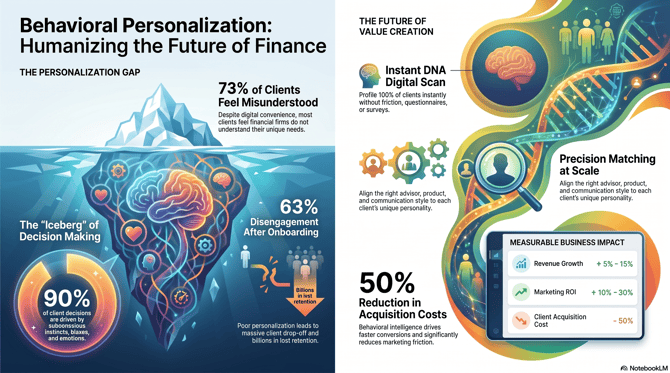
- 73% of clients feel financial firms do not truly understand them.
- 72% regret advice they have received in the past.
- Up to 63% of fintech clients disengage after onboarding because interactions lack personal relevance.
- Many firms automate processes without improving the human connection.
The result is lower engagement, weaker trust, and missed growth opportunities.
Behavioral personalization addresses these challenges by focusing on the human factors that drive decision-making.
What Is Behavioral Personalization?
Behavioral personalization is the process of tailoring communication, experiences, recommendations, and engagement strategies based on an individual's natural behavioral tendencies.
Think of it as providing every client with a tailor-made suit instead of expecting everyone to wear the same standard size.
Rather than relying on assumptions, intuition, or generic customer personas, behavioral personalization uses objective behavioral data to create more meaningful interactions from the very beginning of the relationship.
You get:
- More relevant client experiences
- Stronger communication alignment
- Better engagement and trust
- Higher conversion and retention rates
- More effective client outcomes
This is not about guessing what people want. It's about understanding how they naturally engage and make decisions.
The Behavioral Iceberg
A useful way to understand behavioral personalization is through the Behavioral Iceberg model.
1. Visible Data (10%)
Traditional systems focus on information that is easy to see and measure, including:
- Demographics
- Net worth
- Transaction history
- Product usage
- Customer segments
These data points explain actions but not motivations.
2. Invisible Data (90%)
Below the surface are the behavioral drivers that influence decisions every day.
These include:
- Natural instincts
- Decision-making styles
- Communication preferences
- Emotional drivers
- Cognitive biases
Behavioral intelligence captures these hidden influences and turns them into actionable insights.
This is where true personalization begins.
The DNA Digital Scan
The technology enabling behavioral personalization at scale is the DNA Digital Scan.
Traditional profiling methods often required lengthy questionnaires and manual interpretation. While valuable, they created friction and limited adoption.
The DNA Digital Scan changes that.
1. Frictionless Profiling
The Digital Scan can profile:
- Clients
- Prospects
- Family members
- Teams
without requiring surveys or lengthy assessments.
Insights can be generated instantly, making personalization practical across large client populations.
2. Proven Reliability
The system has been validated against 3.25 million users and delivers:
- 70–75% predictive reliability
- More than 4,000 behavioral insights
- Immediate behavioral guidance at scale
3. Expanding Personalization
Historically, personalized service was reserved for the top 20% of clients because it was too expensive and time-consuming to deliver broadly.
Behavioral technology changes the economics.
Organizations can now provide highly personalized experiences across approximately 98% of their client base, creating a much broader impact.
Precision Matching in Action
Behavioral data enables what DNA Behavior describes as Precision Matching.
The goal is simple:
Deliver the right solution, in the right way, by the right person, at the right time.
Advisor-to-Client Matching
Behavioral insights help align clients with advisors or AI-driven support experiences that naturally fit their communication and decision styles.
This can improve trust, engagement, and relationship quality from the beginning.
Lead Nurturing
Behavioral intelligence allows organizations to personalize engagement strategies from the first interaction.
Instead of generic messaging, prospects receive communication that aligns with how they naturally process information and make decisions.
Client Re-Engagement
Dormant clients can be reactivated through communication and solutions tailored to their behavioral preferences.
This creates more relevant conversations and increases the likelihood of renewed engagement.
Business Impact
Organizations implementing Human-First AI and behavioral personalization can achieve measurable outcomes across growth, efficiency, and compliance.
Revenue and Growth
Behavioral personalization can:
- Increase revenue by 5–15%
- Improve marketing ROI by 10–30%
- Increase client engagement
- Strengthen client lifetime value
Cost Reduction
Organizations can reduce client acquisition costs by up to 50% through more targeted and relevant engagement strategies.
Retention and Loyalty
When clients feel understood, they are more likely to:
- Remain engaged
- Expand relationships
- Increase share of wallet
- Stay loyal over time
Regulatory Alignment
Regulatory expectations continue to evolve toward evidence-based personalization and measurable client outcomes.
Behavioral intelligence provides objective data that supports these requirements while improving the client experience.
Why It Matters
Technology alone is no longer enough to create sustainable value.
The next phase of growth belongs to organizations that combine technological intelligence with human understanding.
Behavioral personalization bridges the gap between automation and empathy. It helps organizations understand not only what clients do, but why they do it.
That understanding leads to stronger relationships, better decisions, and more meaningful outcomes for both clients and organizations.
Summary
The Personalization Age is redefining how value is created.
Behavioral personalization moves beyond demographics and transaction data to reveal the hidden drivers behind human decisions. Through technologies such as the DNA Digital Scan, organizations can scale personalized experiences, improve engagement, reduce costs, and create stronger client outcomes.
The organizations that succeed will be those that balance intelligent technology with genuine human understanding.