![DNA-B-Primary_White (7).png]](https://kb.dnabehavior.com/hs-fs/hubfs/DNA-B-Primary_White%20(7).png?height=50&name=DNA-B-Primary_White%20(7).png)
Leadership quality is one of the strongest predictors of organizational resilience, particularly during periods of uncertainty, rapid change, and economic pressure. Traditional leadership development has long focused on teaching skills and competencies. Behavioral Leadership takes a different approach.
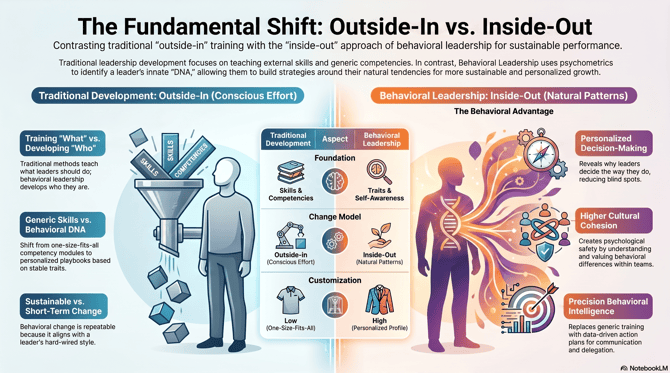
Instead of concentrating primarily on what leaders do, Behavioral Leadership focuses on who leaders are. It recognizes that lasting leadership performance is driven by underlying behavioral patterns, self-awareness, and natural decision-making tendencies.
This represents a shift from generalized leadership training to precision behavioral intelligence. Rather than attempting to make every leader fit the same model, Behavioral Leadership helps individuals understand and work with their natural strengths, tendencies, and blind spots.
The Foundation of Behavioral Leadership
At the center of Behavioral Leadership is the concept of behavioral DNA.
Behavioral DNA refers to the stable behavioral traits that influence how leaders think, communicate, make decisions, manage risk, respond to stress, and lead others. These patterns remain relatively consistent over time and affect how leadership skills are expressed in real-world situations.
Traditional leadership development often assumes that leaders can learn new behaviors through instruction and practice alone. Behavioral Leadership recognizes that learned skills are filtered through an individual's natural behavioral makeup.
Self-awareness becomes the starting point.
When leaders understand their natural tendencies, they can make more intentional choices, improve performance, and lead more effectively.
Behavioral Leadership vs Traditional Leadership Development
The difference between these approaches is significant.
| Aspect | Behavioral Leadership | Traditional Leadership Development |
|---|---|---|
| Foundation | Behavioral traits and self-awareness | Skills and competencies |
| Change Model | Inside-out | Outside-in |
| Decision-Making | Trait-driven and personalized | Best-practice driven |
| Customization | High (individual-level) | Moderate (role-level) |
| Sustainability | High (built on natural strengths) | Lower (requires ongoing reinforcement) |
| Focus | Who the leader is | What the leader does |
Traditional leadership development provides frameworks, models, and best practices. Behavioral Leadership provides insight into the person applying those frameworks.
Both approaches can be valuable, but Behavioral Leadership adds the precision needed to create more sustainable change.
How Behavioral Leadership Works
1. Build Self-Awareness
The process begins by identifying a leader's natural behavioral profile.
Using behavioral assessment tools such as DNA Behavior, leaders gain insight into:
- Communication preferences
- Decision-making tendencies
- Risk tolerance
- Stress responses
- Leadership style
- Team interaction patterns
This creates a clear picture of how a leader naturally operates.
2. Identify Behavioral Strengths
Every leadership style brings advantages.
Some leaders excel at innovation and rapid decision-making. Others thrive through consistency, analysis, relationship-building, or operational discipline.
Behavioral Leadership helps leaders recognize and maximize these natural strengths rather than constantly trying to imitate someone else's leadership style.
3. Recognize Blind Spots
The same traits that create strengths can also create challenges.
For example:
- A highly decisive leader may overlook important details.
- A cautious leader may delay action when speed is required.
- A relationship-focused leader may avoid difficult conversations.
- A highly analytical leader may struggle to build urgency.
Understanding these tendencies allows leaders to proactively manage potential weaknesses.
4. Develop Practical Strategies
Instead of forcing behavior change that conflicts with natural tendencies, Behavioral Leadership develops practical strategies that work with a leader's behavioral profile.
This creates improvements that are easier to maintain over time because they align with how the individual naturally thinks and operates.
The Inside-Out Model of Change
One of the most important distinctions between Behavioral Leadership and traditional leadership training is the approach to change.
Traditional programs often use an outside-in model.
Leaders attend workshops, complete training modules, and learn new frameworks. While valuable, these approaches often require continuous effort to override natural tendencies.
Behavioral Leadership uses an inside-out model.
The process starts with self-awareness and behavioral understanding. Leaders learn how their natural wiring influences performance and then build strategies around those insights.
Because the changes align with existing behavioral patterns, improvements are often more predictable, repeatable, and sustainable.
Decision-Making Through a Behavioral Lens
Decision-making is one of the most important responsibilities of leadership.
Traditional leadership development frequently teaches universal decision-making frameworks and best practices. While useful, these approaches often assume all leaders process information similarly.
Behavioral Leadership reveals why leaders make decisions the way they do.
It helps leaders understand:
- Their natural relationship with risk
- Their preference for speed versus analysis
- Their tendency toward big-picture or detail-oriented thinking
- Their approach to collaboration and consensus
This awareness improves consistency and helps leaders identify areas where additional perspectives may be needed.
This is not about changing how leaders think. It's about helping them understand how they think.
The Power of Personalization
Traditional leadership programs are often designed around job roles, organizational levels, or competency models.
Behavioral Leadership is personalized to the individual.
Each leader receives insight specific to their behavioral profile and leadership style.
This creates a practical leadership playbook that can support:
- Communication effectiveness
- Delegation strategies
- Conflict management
- Team alignment
- Coaching conversations
- Personal performance improvement
No two leaders receive exactly the same roadmap.
That's the point.
Impact on Organizational Culture
Behavioral Leadership does more than improve individual performance.
It can influence organizational culture.
When teams understand behavioral differences, they are more likely to:
- Appreciate diverse perspectives
- Reduce unnecessary conflict
- Improve collaboration
- Increase transparency
- Strengthen psychological safety
- Build stronger working relationships
Differences become predictable strengths rather than sources of frustration.
This creates more aligned and resilient teams.
The DNA Behavior Advantage
Behavioral Leadership becomes even more powerful when supported by behavioral analytics platforms such as DNA Behavior.
DNA Behavior helps organizations move beyond theory and into measurable behavioral intelligence.
The approach helps organizations:
Predict Leadership Style
Behavioral assessments such as Financial DNA and Business DNA identify natural leadership tendencies and behavioral patterns.
Personalize Development
Leaders receive practical recommendations tailored to their specific behavioral profile.
Connect Behavior to Performance
Organizations can better understand how leadership behavior influences business outcomes, team performance, and organizational effectiveness.
Scale Leadership Development
Behavioral intelligence creates a consistent framework for hiring, coaching, succession planning, and leadership development across the organization.
Why Behavioral Leadership Matters
Organizations face increasing complexity, faster decision cycles, and greater pressure to adapt.
Leadership development that focuses only on skills often misses the underlying drivers of performance.
Behavioral Leadership addresses those drivers directly.
By helping leaders understand themselves first, organizations create stronger decision-makers, more effective communicators, and more resilient leadership teams.
This is not simply a leadership training program.
It is a precision behavioral intelligence framework designed to help leaders perform at their best by working with human nature rather than against it.
Summary
Behavioral Leadership shifts the focus from teaching leadership techniques to understanding the behavioral patterns that drive leadership performance.
Through self-awareness, personalized development, and behavioral intelligence, leaders gain a deeper understanding of how they think, decide, communicate, and lead.
The result is more consistent performance, stronger teams, and leadership development that lasts.