![DNA-B-Primary_White (7).png]](https://kb.dnabehavior.com/hs-fs/hubfs/DNA-B-Primary_White%20(7).png?height=50&name=DNA-B-Primary_White%20(7).png)
Business associations often face a common challenge: low engagement from members, limited service utilization, inconsistent team performance, and difficulty creating meaningful connections between people and opportunities.
The DNA Behavior framework provides a structured roadmap for solving these challenges through behavioral intelligence. By understanding how people naturally think, communicate, make decisions, and engage with others, associations can create stronger member experiences, improve internal performance, and increase organizational growth.
Built around a people-centric philosophy, the framework helps leaders align individuals with opportunities, communications, services, and roles that fit their natural behavioral tendencies.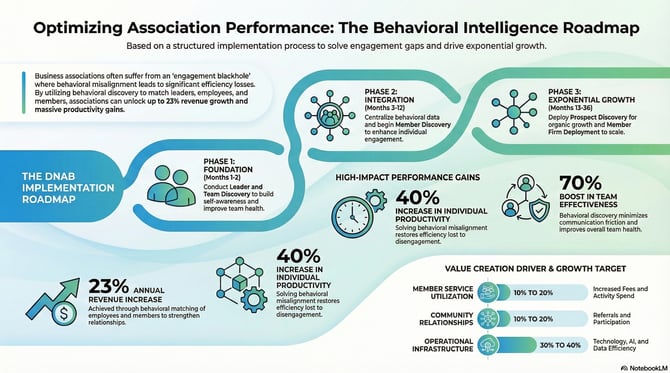
The Core Philosophy
DNA Behavior is a behavioral intelligence infrastructure platform designed to help leaders create people-centric organizations.
The framework is based on the understanding that natural behavioral propensities are largely established by approximately age seven and continue to influence how people communicate, make decisions, respond to challenges, and perform under pressure throughout their lives.
Rather than treating everyone the same, behavioral intelligence helps associations understand and work with individual differences.
This creates better alignment across:
- Leadership teams
- Employees and staff
- Members
- Prospects
- Business partners
- Member firms
The goal is simple: align people with opportunities that fit how they naturally operate.
Understanding the Engagement Blackhole
Many associations struggle with what DNA Behavior describes as the 60% Engagement Blackhole.
This occurs when members, prospects, employees, and leaders are behaviorally misaligned. The result is reduced trust, poor communication, low participation, and missed growth opportunities.
Common outcomes include:
- A 92% breakdown in organizational trust
- Only 30% of individuals reporting satisfaction at work
- 80% of members failing to fully utilize available services
- Team members operating at 40% lower efficiency when behaviorally misaligned
- Teams becoming up to 70% less effective
These issues often appear as operational or communication problems on the surface. In reality, they are frequently rooted in behavioral mismatches.
How the Roadmap Works
The roadmap follows a structured six-step implementation process designed to transform an association into a behaviorally intelligent organization.
1. Leader Discovery (Month 1)
The process begins with leadership.
This stage focuses on helping leaders understand their own behavioral DNA and identify factors that may be limiting performance.
Activities include:
- DNA discovery and behavioral assessment
- Leadership business reviews
- Identification of behavioral blockages
- Development of trust and self-awareness
Effective transformation starts with leadership understanding itself first.
2. Team Discovery (Month 2)
The next step extends behavioral awareness across the association's staff and internal teams.
Key objectives include:
- Improving communication
- Reducing internal friction
- Building stronger working relationships
- Increasing team health and alignment
When teams understand behavioral differences, collaboration becomes more productive and efficient.
3. Central Data Management (Months 3–12)
This phase establishes the behavioral infrastructure required to scale insights throughout the organization.
Key focus areas include:
- Humanizing member data
- Accelerating member understanding
- Building behavioral intelligence databases
- Utilizing AI-powered behavioral insights
- Creating precision matching capabilities
The result is a centralized system that allows leaders to understand members beyond traditional demographic information.
4. Member Discovery (Months 3–12)
Member Discovery directly addresses engagement challenges.
Associations use behavioral intelligence to better align members with opportunities, communications, and services.
Activities include:
- Matching members with appropriate business development opportunities
- Creating personalized member dossiers
- Customizing communications
- Tailoring membership experiences
- Increasing service utilization
This helps members receive more relevant support and value from their membership.
5. Prospect Discovery (Months 13–36)
Once internal systems and member engagement processes are established, associations can use behavioral intelligence to support growth initiatives.
This includes:
- Behavior-based marketing campaigns
- Customized content delivery
- Behavioral matching for lead generation
- More relevant prospect engagement
The goal is higher-quality member acquisition and stronger conversion outcomes.
6. Member Firm Deployment (Anytime)
The final phase extends behavioral intelligence services to member organizations.
Associations can provide value-added services such as:
- Leadership development
- Team and culture analysis
- Employee engagement initiatives
- Customer engagement strategies
- Organic sales growth programs
This creates additional value for member firms while strengthening the association's role as a strategic partner.
Discovery Options and Accuracy Levels
The platform offers multiple discovery methods depending on organizational needs and desired accuracy levels.
| Discovery Method | Accuracy | Time Required | Participation |
|---|---|---|---|
| AI Digital Scan | 70–75% | Instant | No active participation |
| Quick Scan | 89% | 3–4 minutes | Minimal participation |
| Full Scan | 97.1% | 10–12 minutes | Full assessment required |
This tiered approach allows associations to balance speed, scalability, and precision.
Behavioral Communication Framework
The framework segments communication into four primary behavioral quadrants:
- Take Charge
- Planned
- Outgoing
- Patient
Understanding these communication styles helps associations create more relevant messaging and stronger engagement strategies.
Instead of sending identical communications to every audience, organizations can tailor messaging to how different people naturally prefer to receive information and make decisions.
Key Business Benefits
Associations implementing behavioral intelligence can experience measurable improvements across multiple performance areas.
Revenue Growth
- More than 20% annual revenue growth potential
- Up to 23% revenue growth for behaviorally matched firms
Productivity Improvements
- Up to 40% overall productivity improvement
- Up to 70% increase in team productivity
Marketing Performance
- 10–30% improvement in marketing return on investment
- Up to 50% reduction in acquisition costs
Member Engagement
- Increased member referrals
- Average of two referrals annually from engaged members
- 10–20% increase in service utilization
Scalability
- Up to 63% improvement in scalability and operational efficiency through behavioral technology adoption
Why Behavioral Intelligence Matters for Associations
Most associations collect significant amounts of data about members. Very few understand the behavioral drivers behind that data.
Behavioral intelligence helps associations move beyond demographics and activity reports to understand why people engage, what motivates participation, and how to create stronger connections.
This is not about collecting more information. It's about making existing relationships more relevant and valuable.
When leaders, teams, members, prospects, and partner organizations become behaviorally aligned, engagement increases, communication improves, and growth becomes more sustainable.
Summary
The Behavioral Intelligence Roadmap provides a practical framework for transforming business associations into people-centric organizations.
Through leader discovery, team alignment, behavioral data infrastructure, member engagement strategies, prospect development, and member firm deployment, associations can create stronger relationships and measurable performance improvements.
The result is a more engaged membership base, a more productive workforce, and a stronger foundation for long-term growth.
Watch the video walkthrough for a detailed overview of the Behavioral Intelligence Roadmap and its implementation within business associations.