![DNA-B-Primary_White (7).png]](https://kb.dnabehavior.com/hs-fs/hubfs/DNA-B-Primary_White%20(7).png?height=50&name=DNA-B-Primary_White%20(7).png)
Mergers and acquisitions are often approached as financial transactions, but their success ultimately depends on people. While traditional due diligence focuses on financial performance, legal obligations, and operational structures, many transactions overlook the behavioral factors that drive decision-making, leadership effectiveness, and organizational culture.
This behavioral blind spot is a significant risk. Leadership decisions influence strategy execution, capital allocation, talent retention, and post-acquisition integration. When these behavioral drivers are not evaluated, organizations may miss critical indicators of future performance.
Behavioral Intelligence provides a framework for measuring and understanding the human factors behind enterprise value creation. It helps investors, private equity firms, corporate acquirers, and leadership teams make more informed decisions throughout the entire M&A lifecycle.
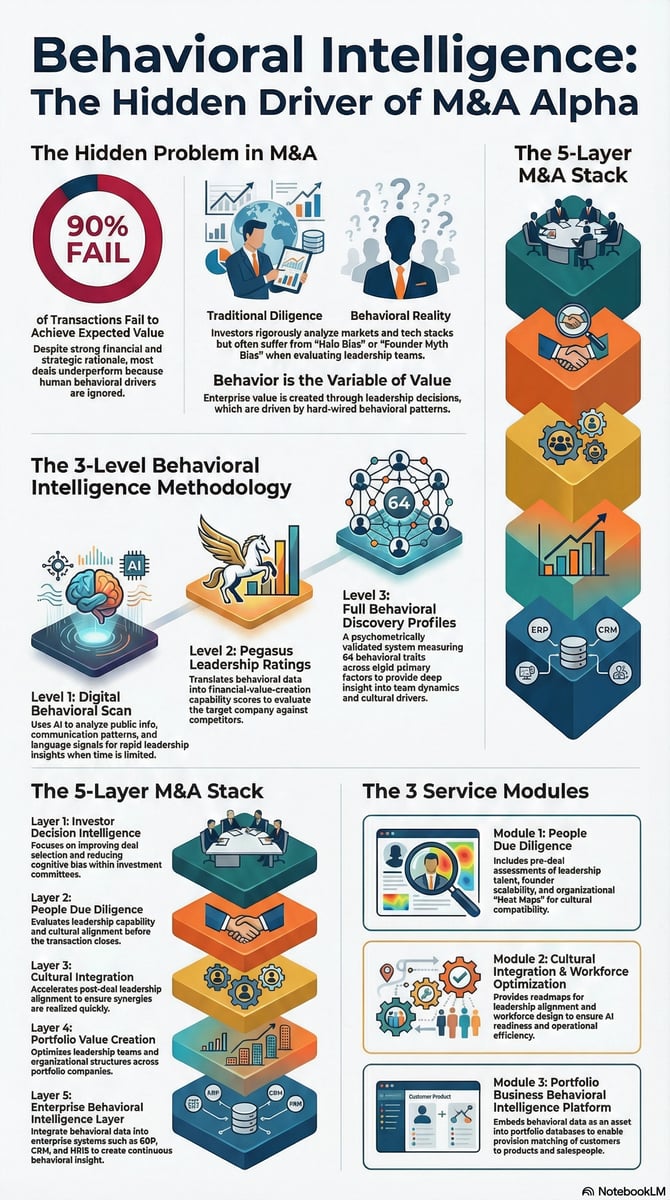
The Behavioral Blind Spot in M&A
Traditional due diligence answers questions about what happened in the past.
Financial statements reveal historical performance. Legal reviews identify contractual obligations. Operational assessments evaluate systems and processes.
What they do not fully explain is how leaders are likely to behave in the future.
Enterprise value is created through decisions. Those decisions are influenced by behavioral patterns that remain relatively consistent over time.
Behavioral Intelligence focuses on understanding:
- Leadership decision-making tendencies
- Risk tolerance and risk management approaches
- Team leadership capabilities
- Strategic thinking patterns
- Cultural influences on performance
- Change management readiness
Financial data explains the past. Behavior helps predict what leaders are likely to do next.
Deep Natural Architecture (DNA)
At the center of the Behavioral Intelligence framework is the concept of Deep Natural Architecture (DNA).
DNA refers to the enduring behavioral patterns that influence how individuals:
- Make decisions
- Evaluate opportunities and risks
- Allocate resources
- Lead teams
- Respond to pressure
- Execute strategic initiatives
These behavioral traits are considered relatively stable and highly predictive of future leadership behavior.
Understanding a leader's behavioral DNA provides insight into how they are likely to perform as organizational demands evolve, particularly during periods of rapid growth, acquisition integration, or operational transformation.
Founder Scalability
One of the most valuable applications of Behavioral Intelligence is evaluating founder scalability.
Many founders possess characteristics that help them launch successful businesses, including:
- High resilience
- Strong vision
- Entrepreneurial risk-taking
- Innovation-focused thinking
However, scaling a company often requires a different set of capabilities.
Successful growth typically depends on balancing three critical leadership roles:
| Leadership Role | Primary Focus |
|---|---|
| Visionary Evangelist | Creates direction and inspires growth |
| Relationship Builder | Strengthens stakeholders and partnerships |
| Execution Manager | Delivers operational consistency and results |
Behavioral Intelligence helps determine whether a founder can successfully evolve into these expanded responsibilities or whether leadership transitions may be necessary to support future growth.
The Three-Level Behavioral Intelligence Methodology
The framework uses a layered approach to evaluate behavioral performance indicators.
1. Digital Behavioral Scan
The first level provides rapid behavioral insights through AI-powered analysis.
This process examines:
- Public information
- Communication styles
- Language patterns
- Behavioral signals
The Digital Behavioral Scan is useful during early-stage screening when investors need quick directional insights about leadership tendencies before deeper assessment begins.
2. Pegasus Leadership Ratings
The second level translates behavioral data into value-creation indicators.
This assessment evaluates behaviors linked to enterprise performance, including:
- Results Drive
- Financial Goal Drive
- Leadership effectiveness
- Strategic execution capability
The platform provides a market valuation trajectory perspective that connects behavioral strengths and limitations to potential business outcomes.
3. Full Behavioral Discovery Profiles
The third level delivers the most comprehensive analysis.
This psychometrically validated assessment measures:
- 64 behavioral traits
- Eight primary behavioral factors
- Executive team dynamics
- Decision-making styles
- Cultural influences
- Leadership alignment
This level provides a detailed understanding of how leadership teams operate individually and collectively.
The Five-Layer M&A Behavioral Intelligence Stack
Behavioral Intelligence can be integrated throughout the entire investment lifecycle.
1. Investor Decision Intelligence
Helps investors make more objective decisions by reducing common biases such as:
- Halo bias
- Confirmation bias
- Similarity bias
- Overconfidence bias
This supports more disciplined deal selection and evaluation.
2. People Due Diligence
Evaluates leadership capability and organizational fit before transactions close.
Areas of focus include:
- Executive leadership strength
- Team dynamics
- Leadership gaps
- Cultural alignment
- Scalability potential
3. Cultural Integration
Supports post-acquisition integration efforts by identifying areas of cultural alignment and friction.
Benefits include:
- Faster integration
- Improved communication
- Better leadership alignment
- Reduced organizational disruption
4. Portfolio Value Creation
Applies behavioral intelligence across portfolio companies to optimize performance.
This can include:
- Leadership development
- Team optimization
- Organizational design
- Succession planning
5. Enterprise Behavioral Intelligence Layer
Embeds behavioral data into enterprise technology systems such as:
- ERP platforms
- CRM systems
- HRIS solutions
This creates continuous visibility into behavioral trends and organizational performance drivers.
Core Service Modules
Behavioral Intelligence is typically delivered through three practical service modules.
Module 1: People Due Diligence (Pre-Deal)
Provides:
- Leadership talent profiles
- Founder scalability analysis
- Executive team evaluations
- Organizational heat maps
- Cultural compatibility assessments
These insights support investment decisions before acquisition completion.
Module 2: Cultural Integration & Workforce Optimization (Post-Deal)
Provides:
- Integration roadmaps
- Leadership alignment workshops
- Workforce design analysis
- Organizational effectiveness recommendations
The goal is to accelerate synergy realization and reduce integration risk.
Module 3: Portfolio Business Behavioral Intelligence Platform
Focuses on treating behavioral data as a strategic business asset.
Organizations can use behavioral insights to:
- Improve customer engagement
- Personalize communication approaches
- Align products with customer behavioral preferences
- Match sales professionals to customer decision styles
- Scale personalization across large populations
Why Behavioral Intelligence Matters
Due diligence has evolved significantly over time.
- The 1980s emphasized financial due diligence.
- The 1990s expanded focus to legal due diligence.
- The 2020s increasingly recognize the importance of behavioral due diligence.
The reason is straightforward.
Financial records explain historical results. Behavioral intelligence provides insight into the decisions that create future results.
Organizations that incorporate behavioral intelligence into M&A processes gain a deeper understanding of leadership capability, cultural fit, integration readiness, and long-term value creation potential.
This leads to:
- Better deal selection
- More effective leadership evaluation
- Faster cultural integration
- Stronger portfolio performance
- Higher enterprise value creation
- Improved exit outcomes
In the end, successful transactions are driven by people. Understanding behavior helps organizations understand the decisions that shape future performance.
Summary
Behavioral Intelligence introduces a structured way to evaluate the human drivers of enterprise value throughout the M&A lifecycle.
Through Deep Natural Architecture analysis, behavioral assessments, leadership ratings, and enterprise-wide behavioral intelligence platforms, organizations gain visibility into factors that traditional due diligence often misses.
The result is a more complete view of investment risk, leadership capability, cultural alignment, and future performance potential.