![DNA-B-Primary_White (7).png]](https://kb.dnabehavior.com/hs-fs/hubfs/DNA-B-Primary_White%20(7).png?height=50&name=DNA-B-Primary_White%20(7).png)
Leadership behavior has a greater impact on business performance than strategy alone. While strategy determines where an organization intends to go, every strategic decision is ultimately made by people, and those decisions are driven by behavior.
The Behavior Makes Money framework explains how a leader's Financial DNA influences profitability, growth, innovation, and organizational culture. Rather than viewing financial performance as purely a function of market conditions or business plans, this approach recognizes that the behavioral patterns of CEOs and leadership teams directly shape how capital is invested, risks are managed, and opportunities are pursued.
Research referenced in this framework indicates that the financial behavior style of a CEO and senior leadership team may influence up to 80% of profitability outcomes through the decisions they make and the culture they create.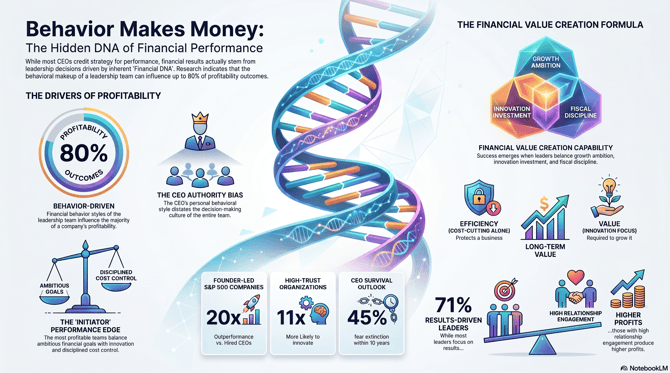
How Financial DNA Works
Every leader possesses a natural financial personality known as Financial DNA. This behavioral wiring influences how they think about money, make decisions, and lead an organization.
1. Capital Allocation
Financial DNA affects how leaders decide where to invest organizational resources.
This includes decisions about:
- Business expansion
- Talent investment
- Technology initiatives
- Acquisitions
- Research and development
Different behavioral styles naturally prioritize different investment opportunities.
2. Risk Management
Leaders approach risk differently based on their natural behavior.
Some naturally pursue growth opportunities aggressively, while others prioritize stability and careful evaluation before committing resources.
Neither approach is inherently right or wrong. Long-term success depends on balancing opportunity with discipline.
3. Financial Decision-Making
Financial DNA also shapes how leaders:
- Set financial goals
- Respond to uncertainty
- Manage costs
- Evaluate investment opportunities
- Make long-term strategic decisions
Because these decisions occur every day, small behavioral differences compound into significant financial outcomes over time.
The Eight Behaviors That Drive Profitability
Research involving S&P 500 leadership teams found that differences in profitability can largely be explained by the strength of key leadership behaviors.
Six of the primary drivers include:
Results Drive
A consistent focus on achieving measurable business outcomes and executing strategic priorities.
Relationship Engagement
Building strong relationships with employees, customers, and stakeholders to create an engaged, high-performing culture.
Financial Goal Drive
Setting ambitious financial objectives and maintaining disciplined focus on achieving them.
This behavior was identified as the strongest individual behavioral predictor of profitability.
Innovation Focus
A willingness to invest in new ideas, products, services, and business models that create future growth.
Fiscal Control
Managing financial resources with discipline while maintaining operational efficiency.
Financial Prudence
Making structured, thoughtful financial decisions that balance opportunity with responsible stewardship.
Together, these behaviors create the leadership foundation required for sustainable financial performance.
Financial Value Creation Capability
Organizations create the greatest long-term value when leadership teams successfully balance three critical elements:
- Financial ambition
- Investment in innovation
- Disciplined cost management
This combination creates what the framework describes as Financial Value Creation Capability.
The research highlights the Initiator behavioral style as consistently producing strong financial outcomes because it naturally combines these three capabilities into a balanced decision-making approach.
Rather than choosing between growth and discipline, successful leaders pursue both simultaneously.
The CEO Authority Bias
A CEO's behavior influences far more than their own decisions.
Leadership teams naturally adapt to the CEO's communication style, priorities, and decision-making approach. This phenomenon is described as CEO Authority Bias, where the leader's behavioral style shapes the culture of the entire executive team.
For example:
- A CEO with strong fiscal control but limited innovation focus may build a highly efficient organization that struggles to grow.
- A highly innovative CEO without sufficient financial discipline may pursue opportunities that place unnecessary pressure on capital and profitability.
The organization's culture often reflects the natural tendencies of its leader.
Balancing Results and Relationships
Leadership often creates tension between achieving results and building relationships.
Research referenced in this framework suggests that approximately 71% of leaders naturally lean toward results-driven behavior.
However, leadership teams with stronger relationship engagement frequently achieve higher profitability over time.
Strong relationships contribute to:
- Greater employee engagement
- Better collaboration
- Improved communication
- Higher customer trust
- More sustainable organizational performance
Results drive execution.
Relationships sustain execution.
The highest-performing organizations develop both.
Why Trust Drives Innovation
Financial discipline alone is not enough to create enterprise value.
Organizations also require trust.
High-trust organizations experience measurable advantages, including:
- Employees who are 11 times more likely to innovate
- 106% more energy at work
- Higher engagement
- Increased productivity
When people feel trusted, they contribute ideas more freely, collaborate more effectively, and adapt more quickly to change.
Innovation becomes part of the culture rather than an isolated initiative.
Where the Framework Is Used
The Behavior Makes Money framework provides practical value across several leadership environments.
Executive Leadership
- Understand how behavioral preferences influence strategic decisions.
- Build more balanced executive teams.
- Improve capital allocation and long-term planning.
Founder-Led Businesses
Founder-led organizations often outperform because founders naturally combine innovation, financial goal drive, and fiscal discipline during periods of growth.
Understanding these behaviors helps preserve that advantage as organizations scale.
Boards and Investors
Private equity firms and boards can evaluate leadership behavior alongside financial metrics when assessing investment opportunities.
The behavioral wiring of leadership often determines whether an investment creates significant enterprise value or simply maintains existing performance.
Organizational Development
Leadership teams can use Financial DNA insights to:
- Improve executive collaboration
- Balance complementary strengths
- Reduce decision-making blind spots
- Strengthen organizational culture
Why It Matters
Business performance is ultimately created through decisions.
Those decisions are influenced by behavior.
The Behavior Makes Money framework shifts attention from strategy alone to the behavioral patterns that produce strategy, shape culture, and determine how organizations invest, innovate, and grow.
Companies survive through effective cost control.
They create lasting enterprise value when leaders can pursue opportunity while maintaining financial discipline.
Understanding Financial DNA helps organizations develop leaders who consistently make better financial decisions and build stronger businesses over time.
Summary
Behavior influences every major financial decision an organization makes.
By understanding Financial DNA, leaders can recognize the behavioral strengths that drive profitability, identify potential blind spots, and build leadership teams capable of balancing innovation, discipline, relationships, and results.
Better leadership behavior leads to better business decisions. Better business decisions create stronger financial outcomes.
For more information you can view this video.