![DNA-B-Primary_White (7).png]](https://kb.dnabehavior.com/hs-fs/hubfs/DNA-B-Primary_White%20(7).png?height=50&name=DNA-B-Primary_White%20(7).png)
In mergers and acquisitions (M&A), financial statements explain the past, and strategic plans outline future intentions. Neither, however, fully predicts how leaders will behave when faced with pressure, growth opportunities, or organizational change.
Behavioral assessment addresses this gap by evaluating the leadership characteristics, decision-making styles, and behavioral patterns of the individuals responsible for driving business performance. By incorporating behavioral data into due diligence, investors gain a clearer picture of how leaders are likely to perform before and after a transaction.
At its core, the philosophy is simple:
Behavior makes money.
The decisions leaders make ultimately influence growth, culture, innovation, risk management, and enterprise value.
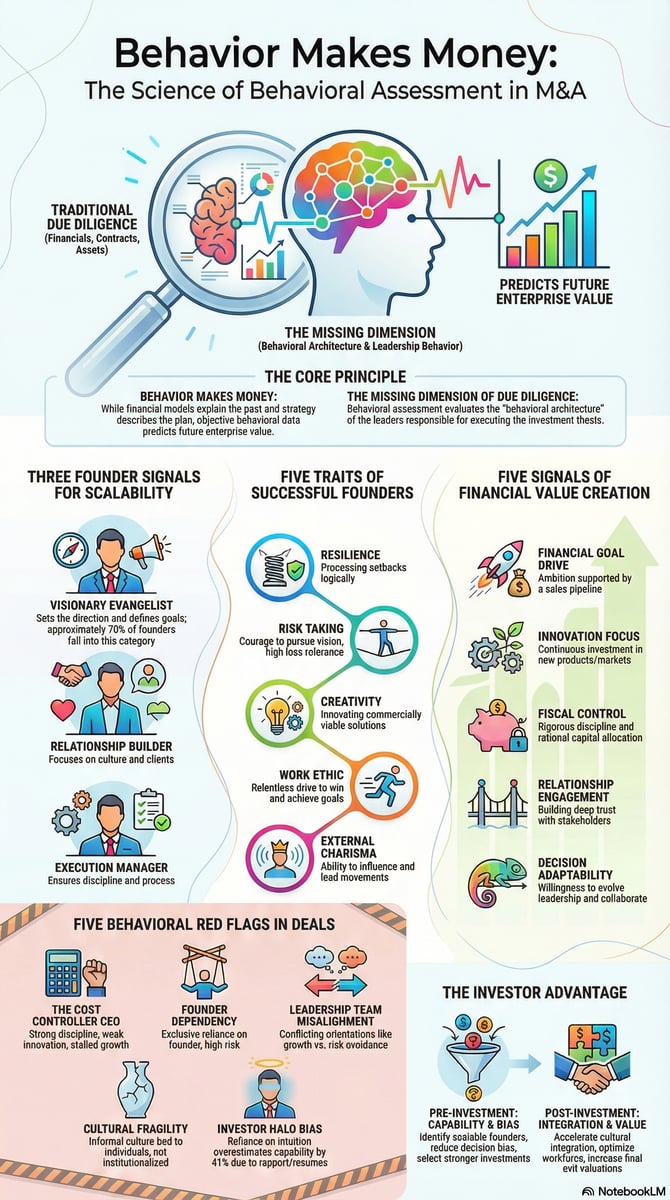
Why Behavioral Assessment Matters in M&A
Traditional due diligence focuses heavily on:
- Financial performance
- Contracts and legal obligations
- Technology and infrastructure
- Market positioning
- Operational processes
While these areas are important, they often overlook the people responsible for producing those results.
Behavioral assessment examines the leadership architecture behind the business. It helps investors understand not only what has happened, but also what is likely to happen next.
This becomes especially important when evaluating founder-led organizations, leadership teams, and businesses undergoing rapid growth or transformation.
The 41% Bias Gap
One of the most significant risks in deal-making is Investor Halo Bias.
Without objective behavioral data, investors frequently rely on:
- Personal impressions
- Executive charisma
- Strong résumés
- Confidence during presentations
- Existing relationships
Research referenced in the source material indicates that investors can overestimate leadership capability by an average of 41% when relying primarily on intuition rather than objective assessment data.
Behavioral assessment introduces measurable psychometric insights that help reduce this bias and support more informed investment decisions.
Key Behavioral Frameworks
Three Founder Signals for Scalability
Successful scaling requires more than vision. High-growth organizations typically demonstrate a balance across three critical leadership functions.
1. Visionary Evangelist
The Visionary Evangelist creates direction, inspires stakeholders, and communicates the future vision of the business.
Characteristics include:
- Strategic thinking
- Market vision
- Delegation of responsibilities
- Growth orientation
Approximately 70% of founders naturally operate in this role.
2. Relationship Builder
The Relationship Builder strengthens the human side of the business.
Key responsibilities include:
- Developing culture
- Supporting employee engagement
- Building client relationships
- Maintaining stakeholder trust
3. Execution Manager
The Execution Manager converts strategy into consistent operational performance.
Responsibilities include:
- Process development
- Operational discipline
- Accountability
- Scalability of systems
Organizations that rely too heavily on only one of these roles often struggle as they grow.
The Five Traits of Successful Founders
High-performing founders commonly demonstrate a combination of five behavioral traits.
Resilience
The ability to remain rational and focused during setbacks, uncertainty, and business challenges.
Risk Taking
A willingness to pursue opportunities despite potential losses or uncertainty.
Creativity
The capability to develop innovative products, services, and solutions that create market value.
Work Ethic
A strong drive to compete, execute, and achieve ambitious business goals.
External Charisma
The ability to influence others, attract support, and build momentum around a vision or brand.
Together, these traits often create the behavioral foundation for sustained growth and leadership effectiveness.
Signals of Financial Value Creation
Behavioral assessment extends beyond personality characteristics. It also identifies behaviors linked to business performance and enterprise value.
Key indicators include:
- Financial Goal Drive – Motivation to build long-term enterprise value.
- Innovation Focus – Commitment to developing new products, services, and markets.
- Fiscal Control – Discipline in managing resources and capital allocation.
- Relationship Engagement – Ability to build trust across employees, customers, and investors.
- Decision Adaptability – Willingness to evolve leadership approaches as the organization grows.
These behavioral factors can provide early signals of future performance that traditional financial analysis may not reveal.
Behavioral Red Flags During Due Diligence
Behavioral assessment can also identify risks that may negatively impact investment outcomes.
Cost Controller CEO
Leaders who excel at operational efficiency but lack innovation capability may struggle to generate future growth.
Founder Dependency
Businesses heavily dependent on a founder's personal relationships and decision-making may face significant transition risk.
Leadership Team Misalignment
Conflicting behavioral orientations within the executive team can create friction, slow decisions, and reduce execution effectiveness.
Cultural Fragility
Cultures built around specific individuals rather than institutional leadership practices can become unstable during organizational change.
Investor Halo Bias
Overreliance on instinct rather than objective behavioral data can lead to inaccurate leadership evaluations and poor investment decisions.
Assessment Tools and Methodology
Behavioral due diligence relies on psychometrically validated assessment tools designed to provide objective insight into leadership capability and organizational fit.
Digital Behavioral Scan
Provides rapid behavioral insights during early-stage deal screening and initial evaluation.
Pegasus Leadership Ratings
Measures leadership effectiveness through a financial value creation lens, helping investors assess leadership impact on enterprise performance.
DNA Natural Behavioral Discovery Profiles
Offers deep psychometric analysis of a leader's natural behavioral architecture, strengths, decision styles, and leadership tendencies.
These tools assess 64 behavioral traits across eight primary behavioral factors, creating a structured framework for leadership evaluation.
How Investors Benefit Across the Investment Lifecycle
Behavioral assessment creates value before, during, and after a transaction.
| Investment Stage | Behavioral Assessment Benefit |
|---|---|
| Pre-Investment | Identifies scalable founders, improves investment selection, and reduces valuation bias |
| Post-Investment | Accelerates leadership integration, cultural alignment, and workforce optimization |
| Growth Phase | Supports leadership development and behavioral matching across teams and customers |
| Exit Strategy | Strengthens organizational resilience and can contribute to higher exit valuations |
By incorporating behavioral intelligence throughout the investment lifecycle, investors gain a more complete understanding of both opportunity and risk.
Why It Matters
Financial due diligence explains what a company has accomplished. Behavioral due diligence helps explain who is likely to create future value.
The most successful investments are not driven solely by products, markets, or financial performance. They are driven by leadership decisions, cultural alignment, adaptability, and execution.
Behavioral assessment provides a structured way to evaluate those factors before they become visible in financial results.
That's the advantage.
Summary
Behavioral assessment adds a critical layer to traditional M&A due diligence by evaluating the people behind the performance.
It helps investors identify scalable leadership teams, reduce bias, uncover hidden risks, and make more informed investment decisions.
Financials tell part of the story.
Behavior reveals what may happen next.